Quinten Matsys (1466, Leuven - 1530, Antwerp)
Musée du Louvre, Paris
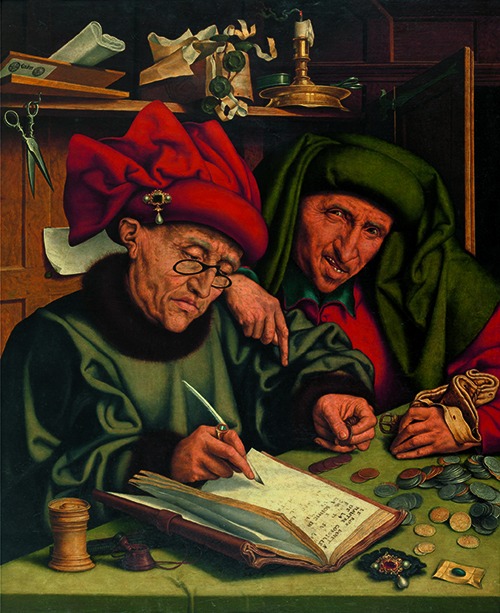
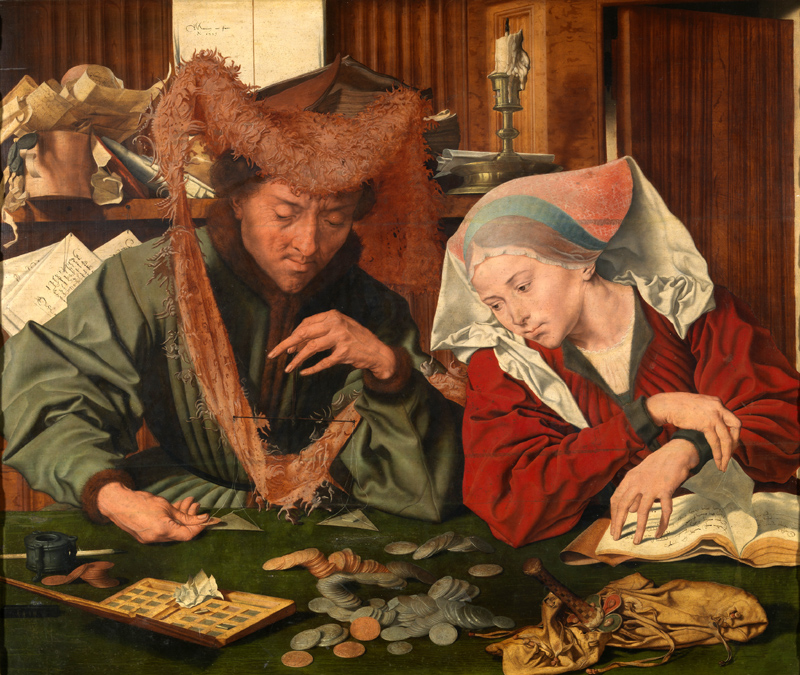
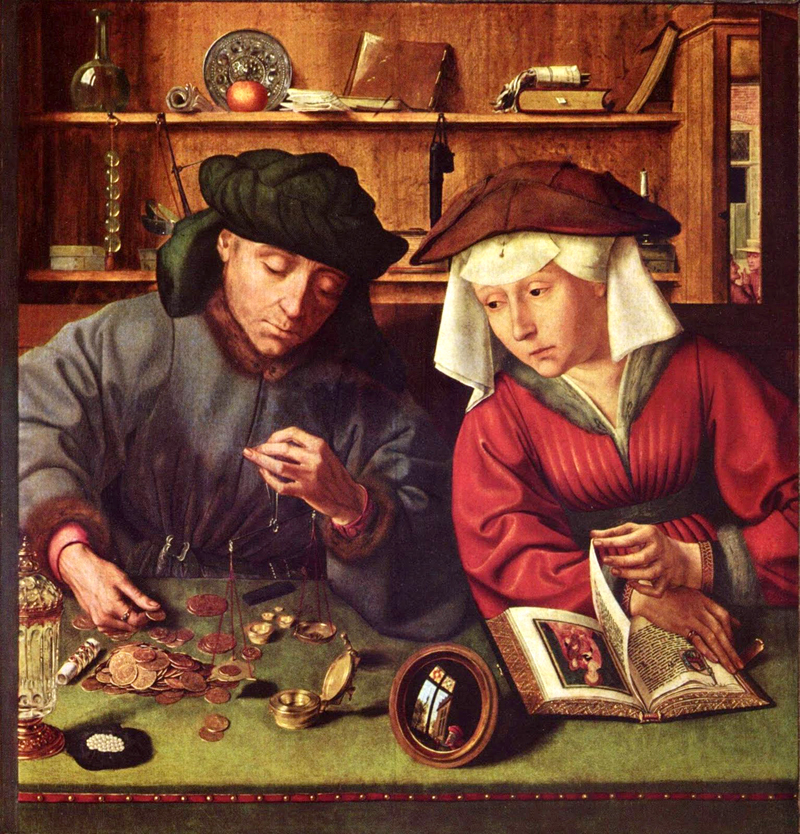
The money changer and his wife
Banking and money changing were relatively new professions at the beginning of the 16th century. In a rapidly changing society, commerce and money were becoming increasingly important.
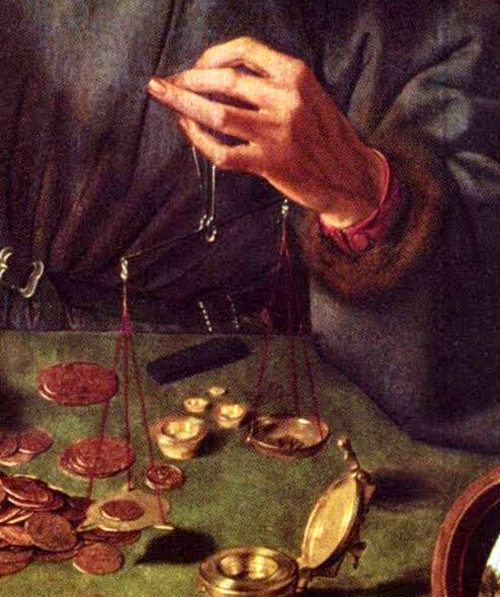
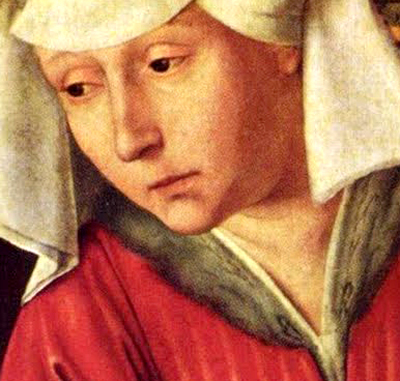
The church warned against the resulting abuses. The man in this panel is absorbed in his work: weighing coins and determining their gold content. His wife watches attentively.
This is an early ‘genre piece’: it is not a portrait but depicts a scene from everyday life. Such scenes often contain a moral lesson or a religious message. They were not made for a specific client, but for the free market.
The painter emphasizes the dignity of both figures. The scene also has a picturesque and psychological aspect.
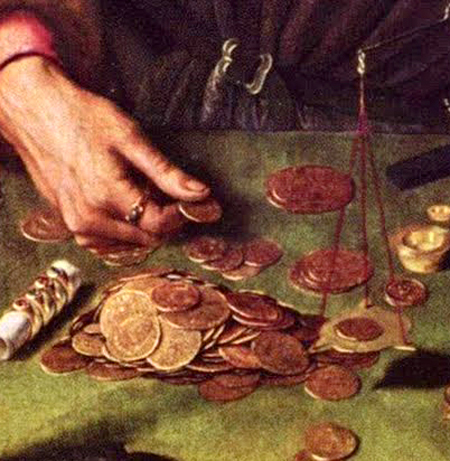
♦ The man is busy sorting and checking all kinds of coins. He weighs them one by one, because there are many counterfeit coins in circulation. It must be a very interesting coin that he is examining so carefully, because even his wife interrupts her reading to take a look at it too.
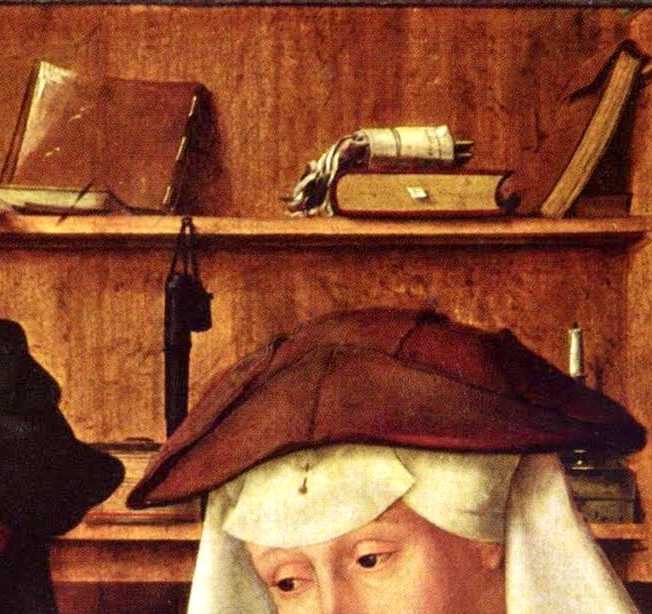
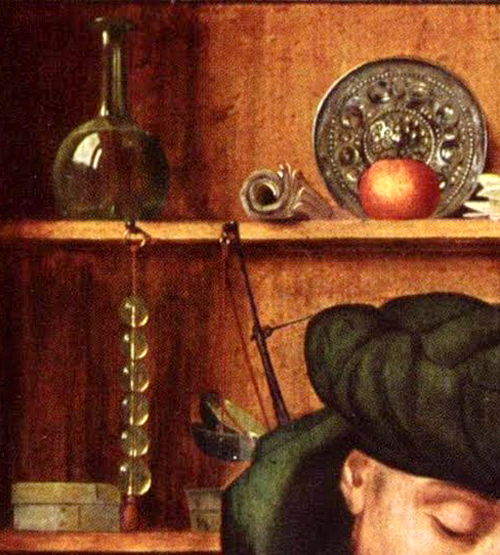
On the table, one sees gold coins, a mirror, and other symbols of the banker's wealth, and in the background, books and all kinds of objects are arranged in a pleasant and orderly manner..
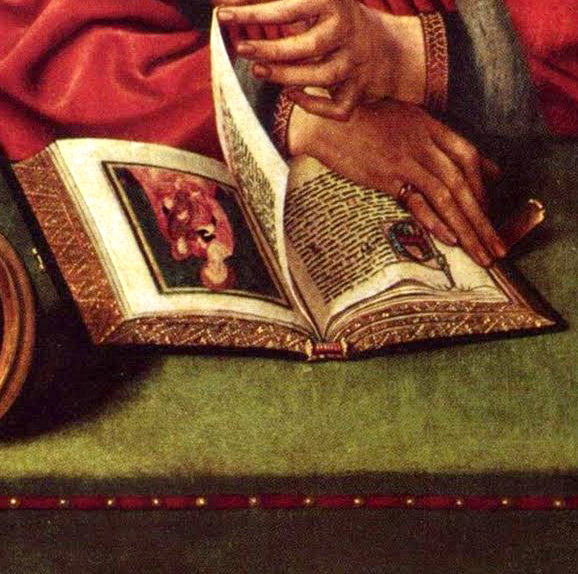
♦ The woman leafs through her illuminated book of hours, a book containing prayers for each day, to a page with a miniature of the Madonna.
She seems more interested in what her husband is doing than in her devotional reading.
In the new commercial metropolis of Antwerp, where Massys was active, should religious values give way to transitory earthly goods and greed? Or should the ‘higher’ values, symbolized here by the book of hours, help this couple on their path to righteousness? Interpretations of Massys' work vary.
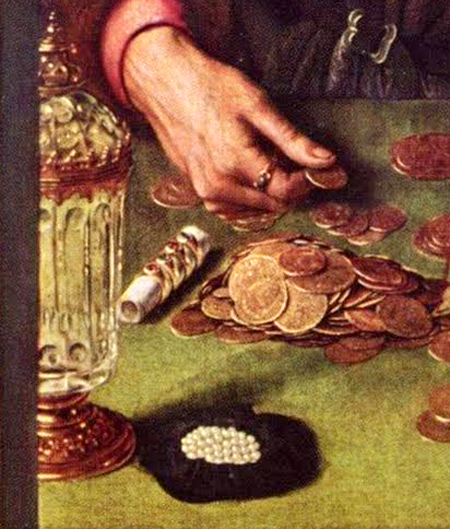
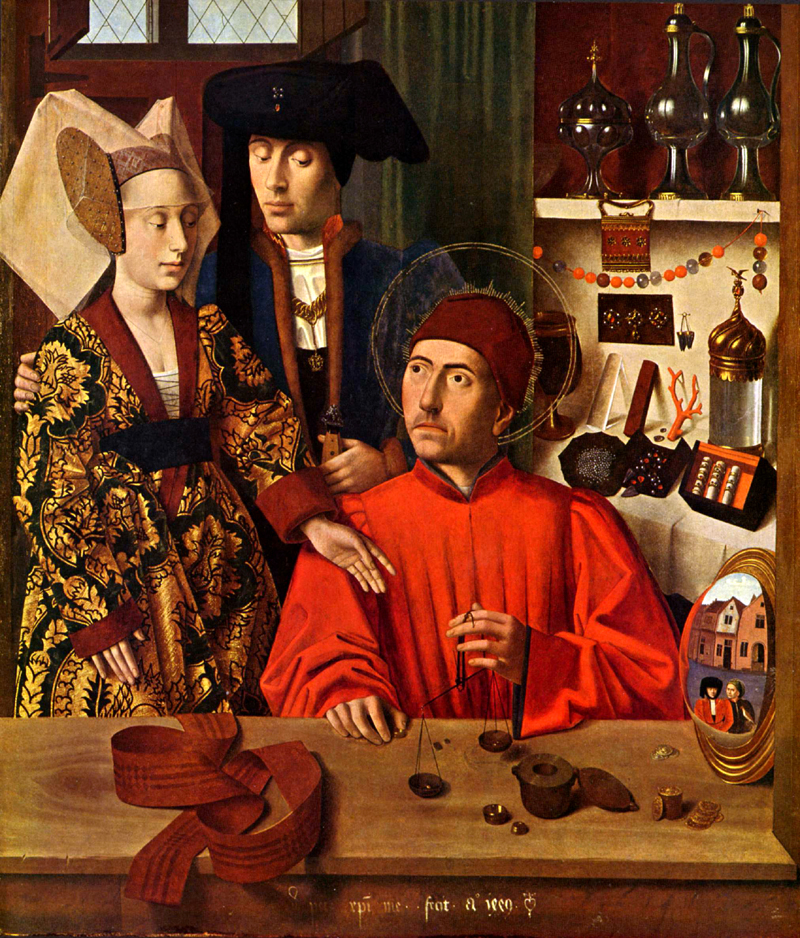
♦ The crystal cup with a gold base and lid and the black velvet cloth with a number of pearls on it have led some to assume that this man is a jeweler.
There is another reason for this: the composition of this panel is reminiscent of an older work by Petrus Christus in which Saint Eligius may be depicted as a goldsmith.
The fact that Massys' couple is dressed in 15th-century Burgundian clothing reinforces the connection with Petrus Christus' painting, although Massys' scene is somewhat ‘desecrated’.
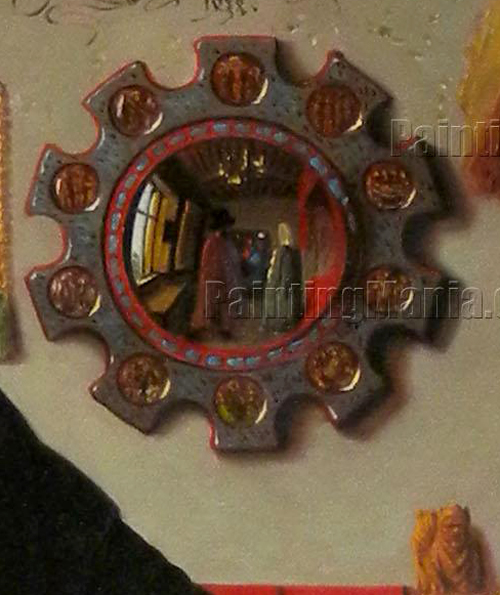
♦ We are familiar with mirrors in paintings from Van Eyck and other artists. Painters can use them to demonstrate their virtuosity. The reflection allows another space to enter the painting, and we sometimes see the painter himself. This mirror reflects an outside window, an outside view, and a man reading.
Yet there is also symbolism: the round mirror also represents the fragility of life.
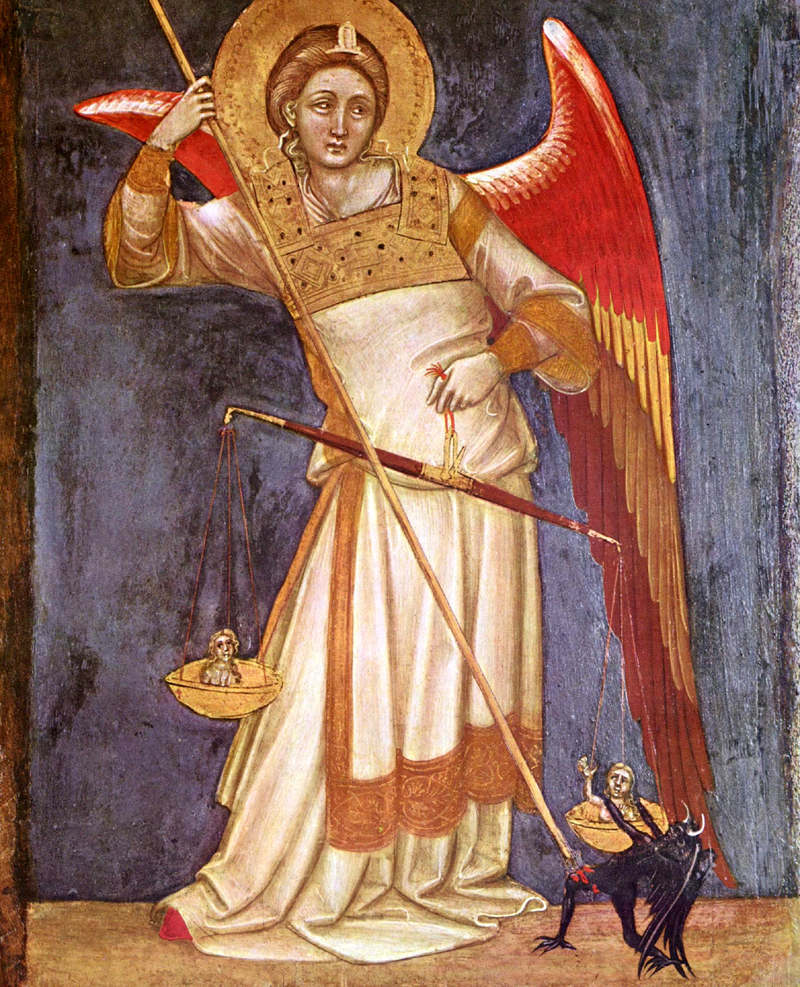
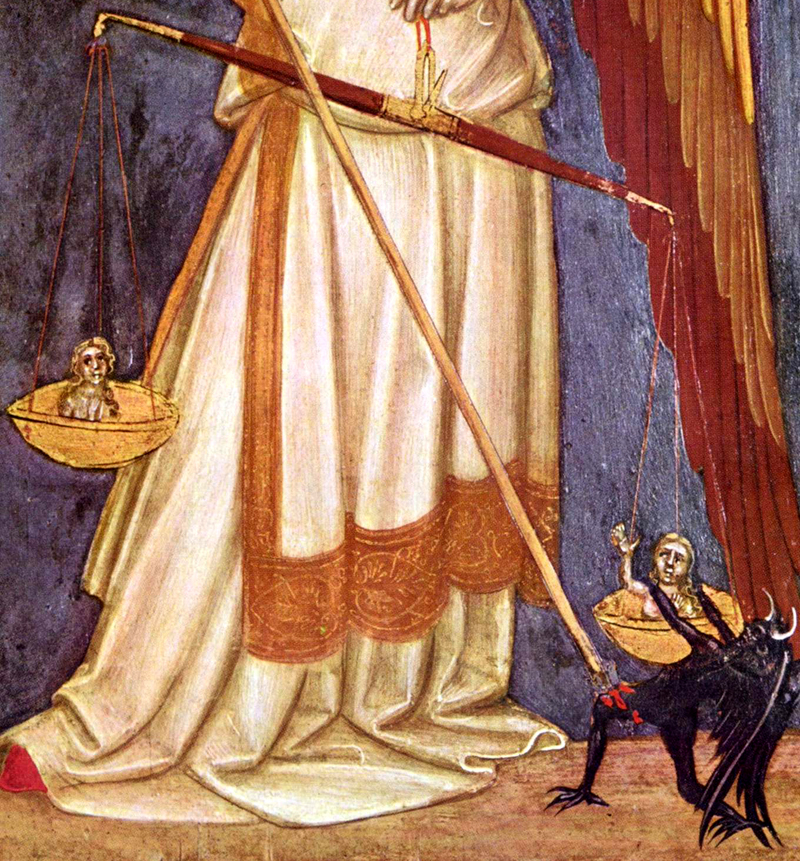
♦ A scale is a traditional symbol for weighing good and evil in the administration of justice. For example, the archangel Michael weighs the souls of the dead during the Last Judgment. But that does not mean that we should interpret all painted scales symbolically.
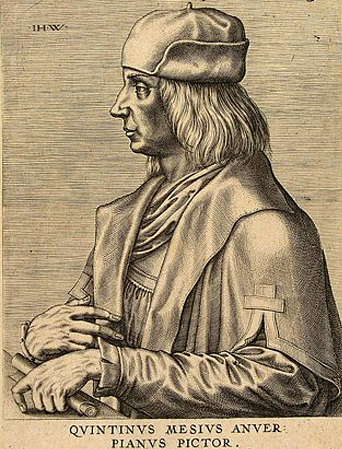
Quinten Matsys
He was a Southern Dutch painter, considered to be the last important representative of the Flemish Primitives.
He was also one of the founders of the Antwerp School.
♦ Life and work
Art historians disagree about Massijs's training, as no documents about it have been found. It is possible that he was trained by Dirk Bouts. This would be the most likely scenario, as both lived in Leuven. However, it is also possible that Massijs learned his craft in Bruges, in Hans Memling's studio. Others believe that he did not receive any formal training in painting at all and was self-taught. What is certain is that Massijs was an accomplished painter when he was admitted to the registers of the Antwerp Guild of Saint Luke as a master painter in 1491.
He mostly painted religious works. His creations are particularly notable for their color palette and balanced compositions. He is considered the first great painter of the Antwerp School. In the beginning, he was still closely aligned with the Flemish Primitives, but later his works began to show traits of the Renaissance style.
His sons Jan Massijs and Cornelis Massijs, children from his second marriage to Catharina Heyns, with whom he had eight other children, were also painters, as was his grandson Quinten Massijs the Younger, who was named after him.
♦ Religious fanaticism
The rigorous religious sentiment that could be said to have been dormant within him proved fatal for two of his relatives.
His sister Catharina and her husband were punished in Leuven for what was then considered a capital offense: reading the Bible. He was beheaded and she was buried alive in the square in front of St. Peter's Church.
Source: symbolism in Western art
the art of seeing
Wikipedia

Matsys, Quinten_The money changer and his wife
References
Source: symbolism in Western art
the art of seeing
Wikipedia
Photos
Wikipedia
Art lijst
Schilderijen
- Bosch, Hieronymus – The Peddler
- Bosch, Hieronymus_The Haywain triptych
- Botticelli, Sandro_Primavera / Spring
- Brueghel the Elder, Pieter – The Tower of Babel
- Campin, Robert — Mérode Triptych
- Courbet, Gustave_The painters Studio
- Dali, Salvadore_The Temptation of Saint Anthony
- Dou, Gerard_the Quack Doctor
- Eyck van Barthélemy_Still life with books
- Fra Angelico_Annunciation
- Géricault, Théodore_Medusas raft
- Magritte, Rene_Prohibited to depict
- Matsys, Quinten_The money changer and his wife
- Memling, Hans_Two horses in a landscape
- Picasso, Pablo_Guernica
- Rembrandt_Abraham and the Three Angels
- Rembrandt_Elsje Christiaens
- Unknown – 16th century: Four depictions of a physician
- Velazquez, Diego_Las Meninas
Schilderijen en de dokter
- Agenesia Sacrale (a rare congenital disorder in which the fetal development of the lower spine)
- Alopecia areata (hair loss)
- Arthrogryposis congenita (birth defect, joints contracted)
- Artritis psoriatica (inflammatory disease of the joint)
- Artritis reumatoïde
- Breast development (delayed)
- Bubonic plague
- Dental caries
- Diphtheria
- Extraction of the Stone of Madness
- Eye surgery
- Flat foot and Pointed Foot
- Fungal disease_Favus
- Gigantism and Acromegaly
- Goiter (struma)
- Hare lip (cheiloschisis) / cleft palate
- Herpes zoster (shingles)
- Hunger edema
- Influenza Epidemic of 1858
- Insanity - Malle Babbe (1640)
- Leprosy
- Lovesick, pregnancy
- Lymph node tumor (lymphoma), non-Hodgkin
- Manic Depression Psychosis
- Measles / Rubella? (acute viral infection)
- Melanoma or nevus (birthmark)
- Membranous glomerulonephritis
- Murder (pneumothorax, arterial bleeding)
- Neurofibromatosis
- Osteoarthritis / hallux valgus
- Osteomyelitis
- Otitis media (acute middle ear infection)
- Parotitis (mumps)
- Polio
- Prepatellar bursitis
- Progeria
- Pseudohermafroditism
- Pseudopregnancy
- Psychoneurosis (acute)
- Pulmonary tuberculosis
- Rachitic chest
- Rheumatic fever (acute)
- Rhinophyma and rosacea_depression
- Rhinophyma or bulbous nose
- Rhinoscleroma
- Syphilis (hard chancre)
- Ziekte van Paget
Schilders
Historie lijst
- 1632-1723_Antonie van Leeuwenhoek
- 1749-1823_Edward Jenner
- 1818-1865_Ignaz Semmelweis
- 1822-1895_Louis Pasteur
Wetenswaardigheden lijst
- 1887 Psychiatric Hospital
- Animals on duty
- Bizarre advice for parents
- Bloodletting
- Bloodthirsty Hungarian Countess Elizabeth Báthory (1560–1614)
- Butler escaped punishment three times.
- Dance mania / Saint Vitus Dance
- Doctors’ advice did more harm than good
- French Revolution Louis XVI
- Frontal syndrome (Phineas Gage)
- Heart disease (Egyptian princess)
- Ice Age (minor)_1300-1850
- Ivan IV de Verschrikkelijke (1530-1584)
- Kindermishandeling
- Koketteren met koningin Victoria
- Koningin door huidcrème vergiftigd
- Kraambedpsychose (Margery Kempe)
- Massacre in Beirut
- ME stonden bol van de seks
- Mummie bij de dokter
- Plee, Gemak of Kakstoel
- Prostaatkanker (mummie)
- Sexhandel in Londen
- Swaddling baby
- Syfilis was in de mode
- Testikels opofferen
- Tropische ziekten werden veroveraars fataal
- Vrouwen als beul in WOII
- Wie mooi wil zijn moet pijn lijden
- Zonnekoning woonde in een zwijnenstal