.jpg)
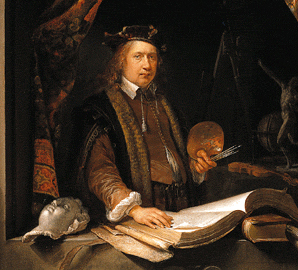
Gerard (Gerrit) Dou
April 7, 1613, Leiden – February 9, 1675, Leiden, Netherlands
Gerard Dou was the son of a glass painter trained as an engraver. He worked in the studio of the young Rembrandt. Although he occasionally ‘borrowed’ themes from Rembrandt, he was more detailed and meticulous in his execution.
His scenes of middle-class domestic life were extremely popular and were often imitated.
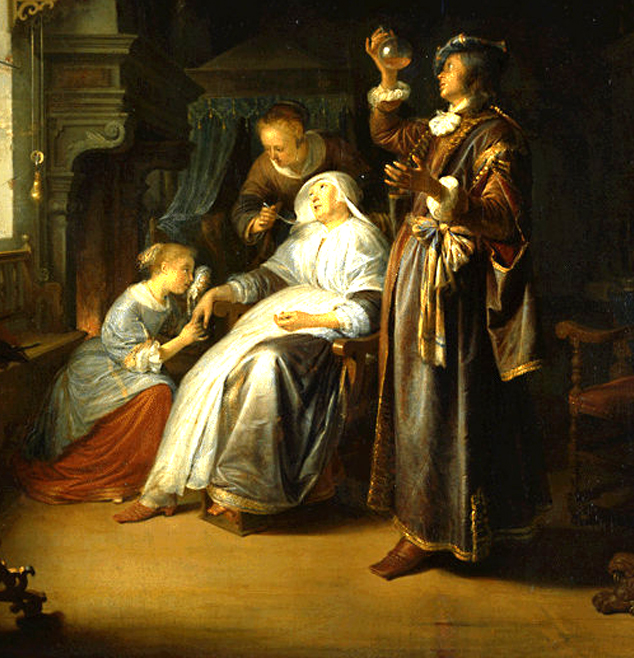
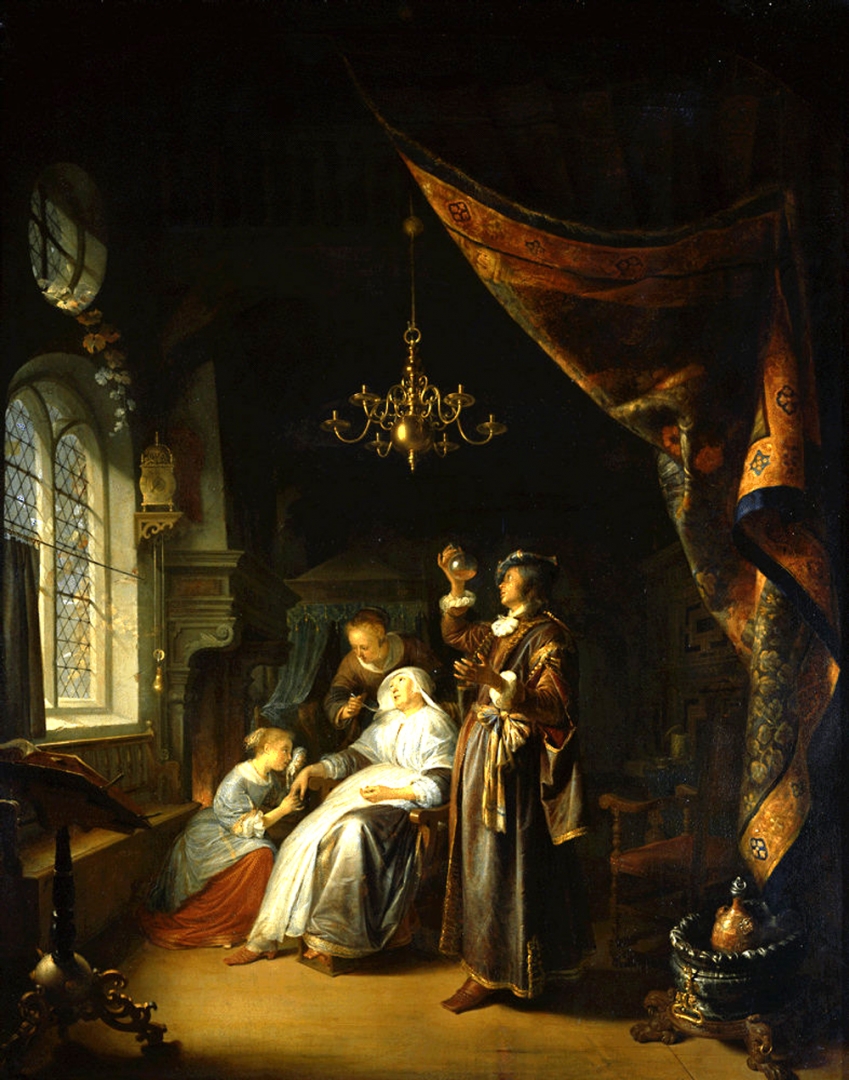
♦ The woman with dropsy ♦
A very sick woman is being cared for in a Dutch patrician house while she is fed with a spoon and mourned by her daughter.
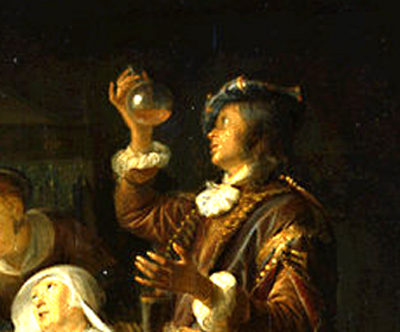
A doctor, wearing a long coat, examines a bottle containing her urine.
♦ Diagnosis
Main symptoms: Edema in the legs, anemia, red sediment in the urine (hematuria), bloated pale face.
Side effects: Middle-aged woman, lethargic.
Clinical diagnosis: Membranous glomerulonephritis.
♦ Definition: membranous glomerulonephritis.
Kidney disease with increased permeability of the glomerular basement membrane (GBM). This causes blood and proteins to enter the urine, often to such a severe degree that it leads to hypoproteinemia and edema.
♦ Discussion
The cause of death is usually elevated urea levels in the blood (uremia), often with anemia or infections as complications.
In other cases, the patient dies from a cerebral hemorrhage, heart failure, or myocardial infarction. Terminal nonbacterial pericarditis (inflammation of the pericardium) is common.
♦ Uroscopy: tool and status symbol
The attributes in this painting draw our attention to two historical medical facts.
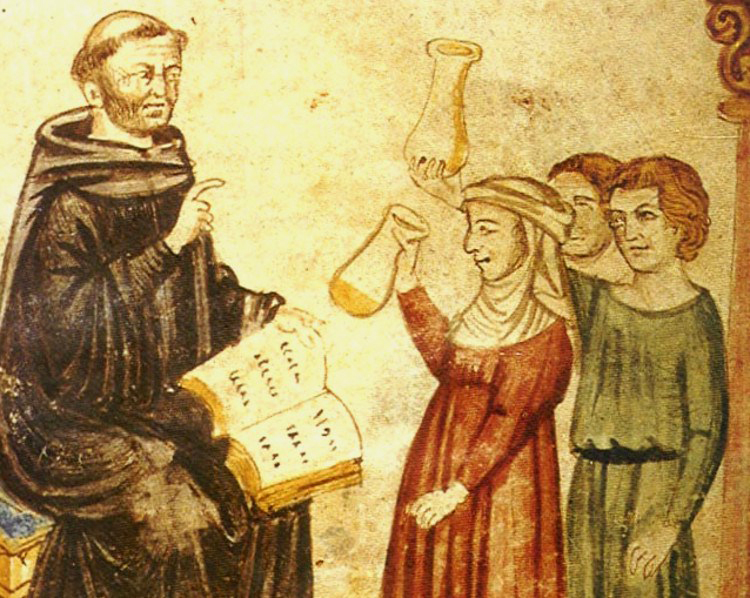
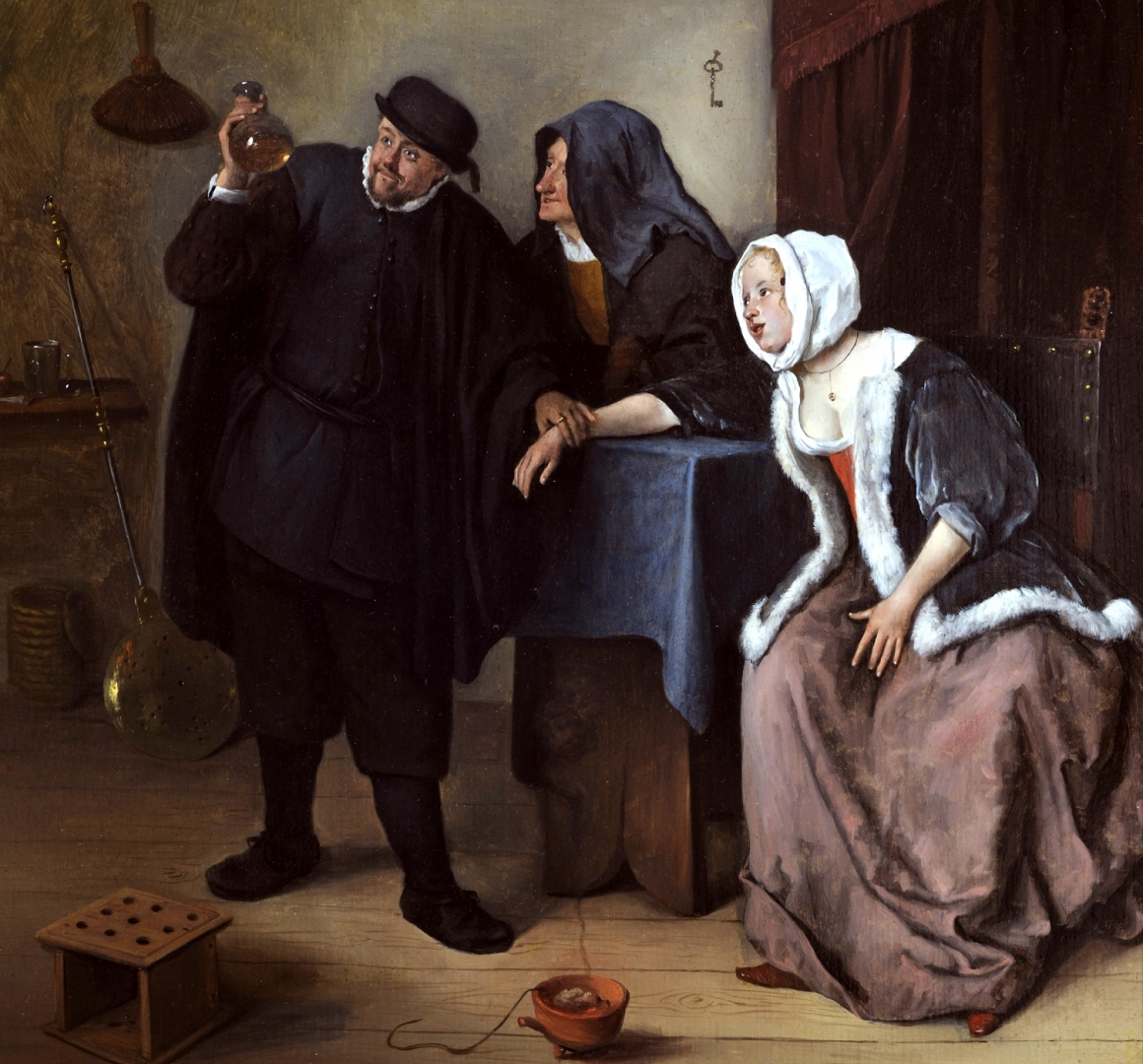
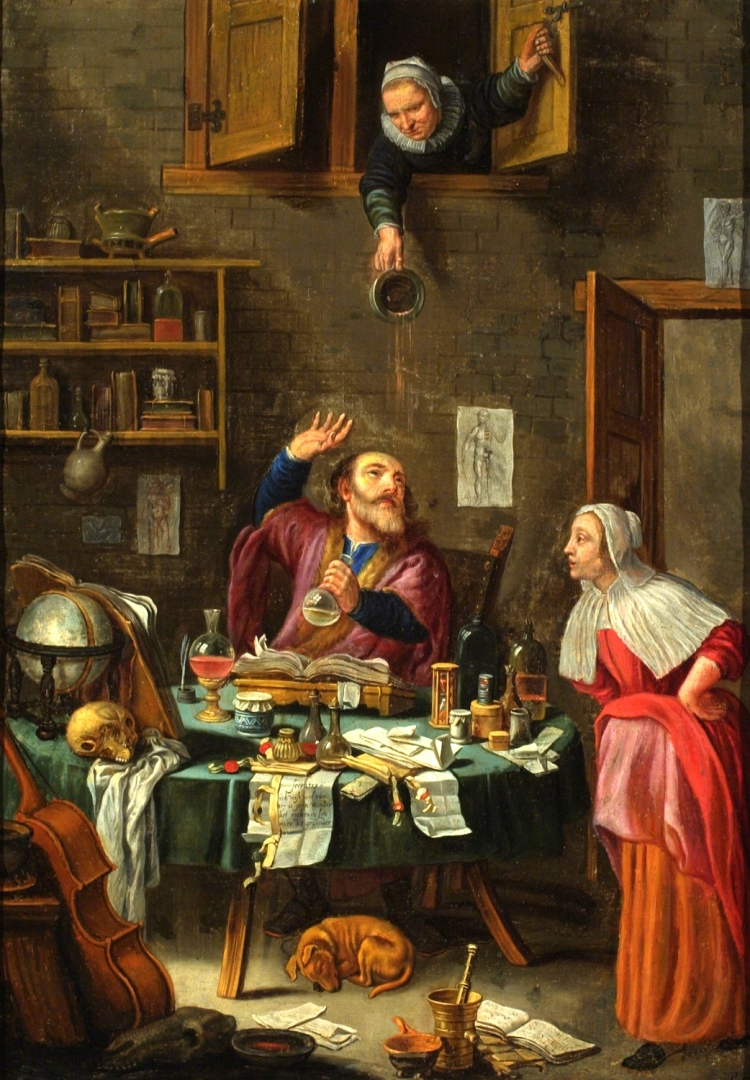
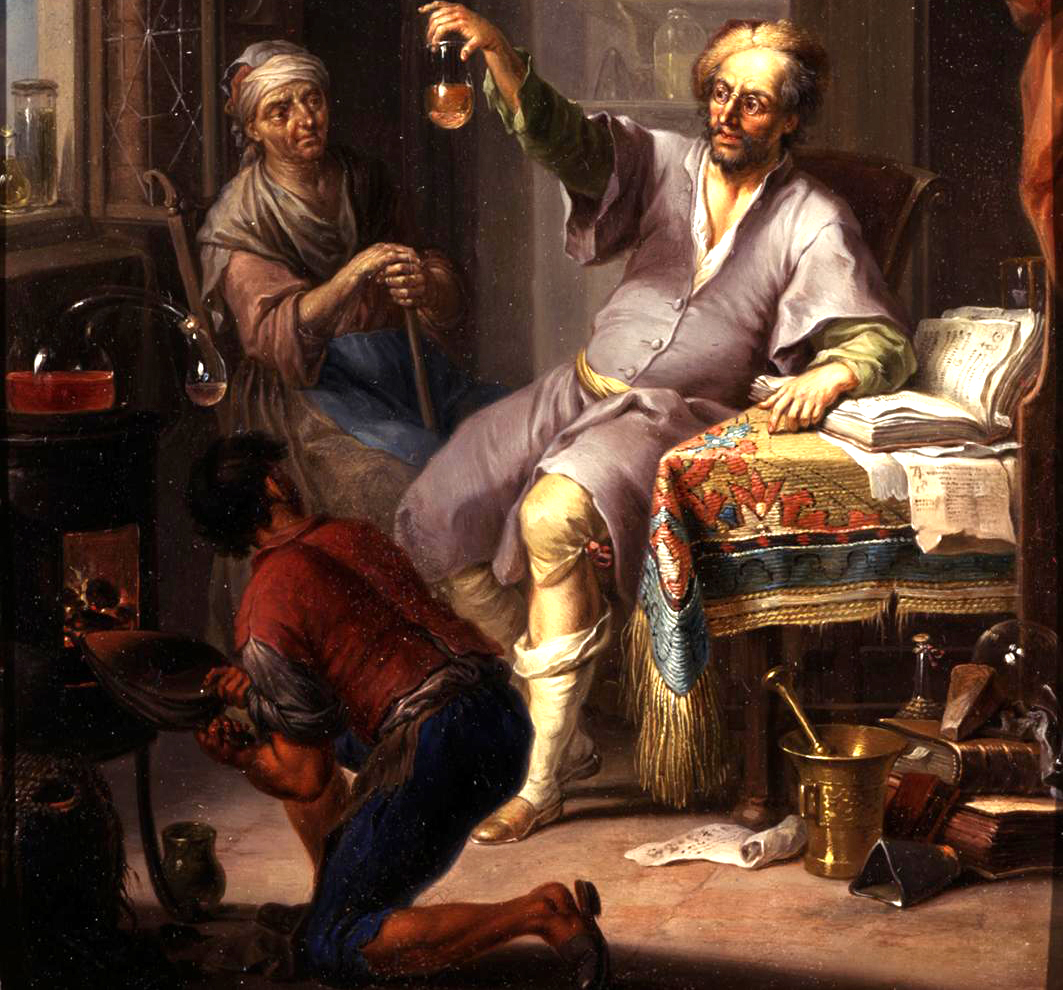
1) Uroscopy (urine examination) as the most highly praised diagnostic tool for academic internal medicine in the early Renaissance, enabling diagnosis from a distance.
2) the difference in status between the academic physician and the artisan surgeon
When Felix Platter (1536-1614), a scientific heir to Vesalius, arrived in his hometown of Basel in 1557, he received a cool reception. His fellow citizens sent him specimens of urine along with false information about a patient in the hope of proving his incompetence. But Platter was so successful in making correct predictions based on uroscopy that he soon gained many followers and became known as one of the most popular doctors of his time.
At that time, a uroscopy was accompanied by a pompous ceremony. A sample of early morning urine was placed in a special bottle that was left to stand for a few hours to allow everything to settle. The doctor then examined the urine against the light and had all the details about color, consistency, and additives noted down. He then shook the bottle, evaluated the floating particles, and compared his findings using color charts and evaluation cards. Finally, he solemnly proclaimed the final diagnosis.
The English physician Thomas Willis put an end to these ceremonies by publishing his Dissertatio de Urinis in 1673, thereby introducing chemical testing of urine. In the same year, he discovered the sweet taste in the urine of a diabetic patient.
In 1694, Dutch physician Frederik Dekkers discovered how to detect albumin (soluble proteins) by boiling urine.
Eventually, uroscopy, or urine examination, became part of medical folklore.
Source: Jan Dequeker

Membranous glomerulonephritis
References
Jan Dequeker
The artist and the doctor look at art
Photos
wikimedia.org
- Constantino die een diagnose stelt met urine
https://www.labrujulaverde.com/2018/04/constantino-el-africano-el-converso-musulman-que-introdujo-en-europa-los-textos-medicos-clasicos-y-arabes
Art lijst
Schilderijen
- Bosch, Hieronymus – The Peddler
- Bosch, Hieronymus_The Haywain triptych
- Botticelli, Sandro_Primavera / Spring
- Brueghel the Elder, Pieter – The Tower of Babel
- Campin, Robert — Mérode Triptych
- Courbet, Gustave_The painters Studio
- Dali, Salvadore_The Temptation of Saint Anthony
- Dou, Gerard_the Quack Doctor
- Eyck van Barthélemy_Still life with books
- Fra Angelico_Annunciation
- Géricault, Théodore_Medusas raft
- Magritte, Rene_Prohibited to depict
- Matsys, Quinten_The money changer and his wife
- Memling, Hans_Two horses in a landscape
- Picasso, Pablo_Guernica
- Rembrandt_Abraham and the Three Angels
- Rembrandt_Elsje Christiaens
- Unknown – 16th century: Four depictions of a physician
- Velazquez, Diego_Las Meninas
Schilderijen en de dokter
- Agenesia Sacrale (a rare congenital disorder in which the fetal development of the lower spine)
- Alopecia areata (hair loss)
- Arthrogryposis congenita (birth defect, joints contracted)
- Artritis psoriatica (inflammatory disease of the joint)
- Artritis reumatoïde
- Breast development (delayed)
- Bubonic plague
- Dental caries
- Diphtheria
- Extraction of the Stone of Madness
- Eye surgery
- Flat foot and Pointed Foot
- Fungal disease_Favus
- Gigantism and Acromegaly
- Goiter (struma)
- Hare lip (cheiloschisis) / cleft palate
- Herpes zoster (shingles)
- Hunger edema
- Influenza Epidemic of 1858
- Insanity - Malle Babbe (1640)
- Leprosy
- Lovesick, pregnancy
- Lymph node tumor (lymphoma), non-Hodgkin
- Manic Depression Psychosis
- Measles / Rubella? (acute viral infection)
- Melanoma or nevus (birthmark)
- Membranous glomerulonephritis
- Murder (pneumothorax, arterial bleeding)
- Neurofibromatosis
- Osteoarthritis / hallux valgus
- Osteomyelitis
- Otitis media (acute middle ear infection)
- Parotitis (mumps)
- Polio
- Prepatellar bursitis
- Progeria
- Pseudohermafroditism
- Pseudopregnancy
- Psychoneurosis (acute)
- Pulmonary tuberculosis
- Rachitic chest
- Rheumatic fever (acute)
- Rhinophyma and rosacea_depression
- Rhinophyma or bulbous nose
- Rhinoscleroma
- Syphilis (hard chancre)
- Ziekte van Paget
Schilders
Historie lijst
- 1632-1723_Antonie van Leeuwenhoek
- 1749-1823_Edward Jenner
- 1818-1865_Ignaz Semmelweis
- 1822-1895_Louis Pasteur
Wetenswaardigheden lijst
- 1887 Psychiatric Hospital
- Animals on duty
- Bizarre advice for parents
- Bloodletting
- Bloodthirsty Hungarian Countess Elizabeth Báthory (1560–1614)
- Butler escaped punishment three times.
- Dance mania / Saint Vitus Dance
- Doctors’ advice did more harm than good
- French Revolution Louis XVI
- Frontal syndrome (Phineas Gage)
- Heart disease (Egyptian princess)
- Ice Age (minor)_1300-1850
- Ivan IV de Verschrikkelijke (1530-1584)
- Kindermishandeling
- Koketteren met koningin Victoria
- Koningin door huidcrème vergiftigd
- Kraambedpsychose (Margery Kempe)
- Massacre in Beirut
- ME stonden bol van de seks
- Mummie bij de dokter
- Plee, Gemak of Kakstoel
- Prostaatkanker (mummie)
- Sexhandel in Londen
- Swaddling baby
- Syfilis was in de mode
- Testikels opofferen
- Tropische ziekten werden veroveraars fataal
- Vrouwen als beul in WOII
- Wie mooi wil zijn moet pijn lijden
- Zonnekoning woonde in een zwijnenstal