

Jan van Eyck
1390, Maaseik – July 19, 1441, Bruges, Belgium
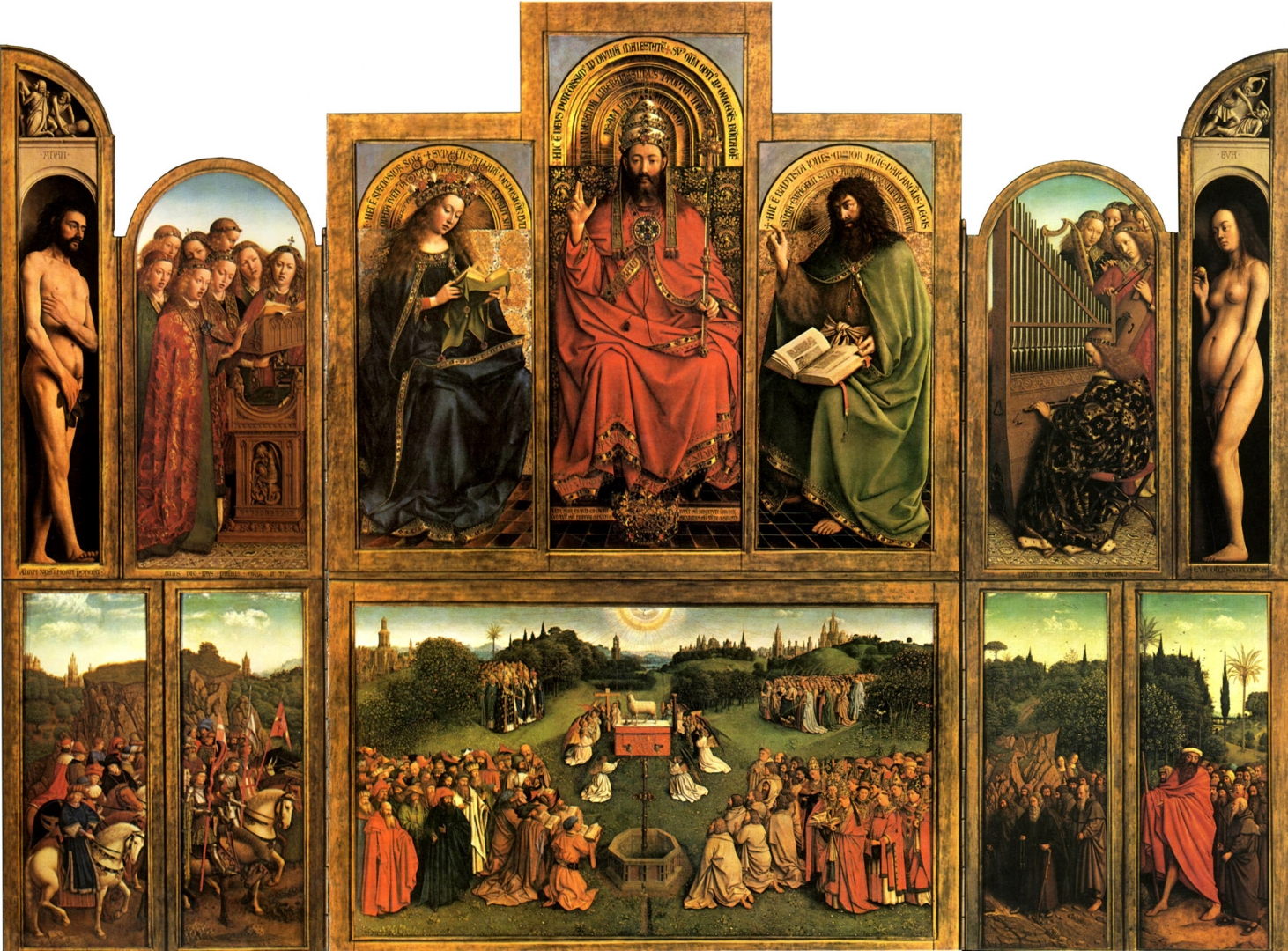
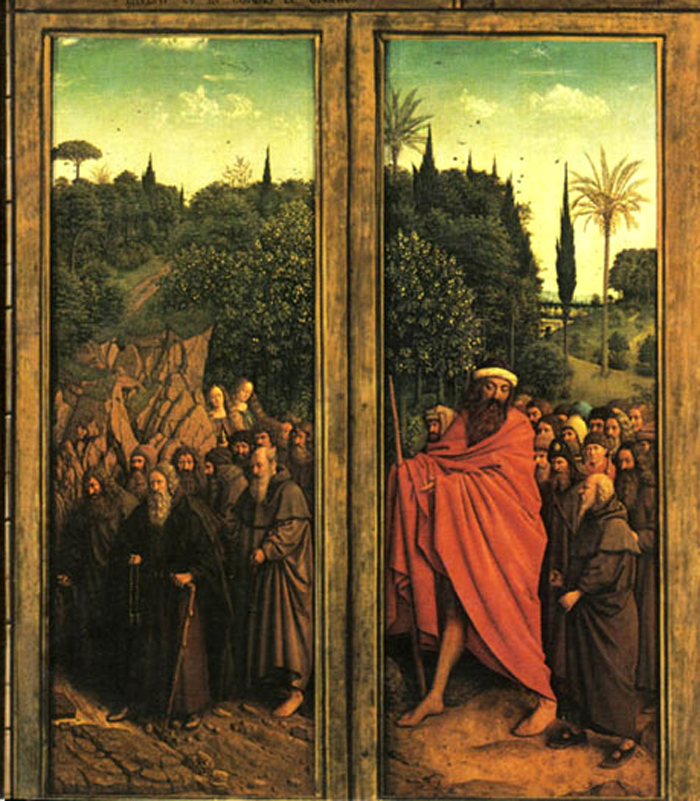
♦ Panel depicting the hermits and pilgrims / The Adoration of the Mystic Lamb ♦
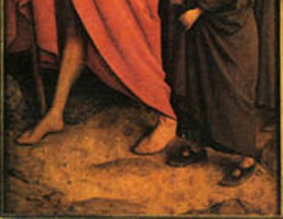
The man in this painting is a giant. He is at least one-third larger than the others.
He is Saint Christopher, who, according to legend, carried pilgrims, including Christ, across the river.
♦ Diagnosis
Important features: large man, giant. Left foot is deformed (clubfoot or equino varus) and his big toe is crooked (hallux valgus).
Side effects: man
Clinical diagnosis: gigantism, acromegaly, secondary osteoarthritis.
♦ Definition: gigantism and acromegaly
There are two types of giantism: gigantism and acromegaly.
Gigantism occurs during adolescence when there is excessive production (hypersecretion) of growth hormones in the period before the ends of the long bones have grown together.
Acromegaly, if hypersecretion occurs only after bone growth has ceased
If it begins during adolescence and continues into adulthood, gigantism and acromegaly can occur together.
♦ Discussion
The characteristic feature of acromegaly is the increase in size of the bones and soft tissue of the hands, feet, the ridges of the eye sockets, the sinuses, and the lower jaw.
The skin becomes thick and rough. The subcutaneous tissue increases in thickness, which is often most easily seen on the tongue, lips, and ears. Internal organs such as the heart, thyroid, and liver also increase in size. Carbohydrate tolerance decreases, and about half of untreated patients have sugar in their urine (glycosuria).
If the disease progresses, the patient often develops osteoarthritis, a degeneration of the cartilage. Kyphosis and muscle weakness may also occur. High blood pressure is a common complication. Mental work becomes more difficult. The patient often becomes irritable and complains of persistent headaches.
Some of these symptoms are due to poor pituitary function caused by pressure from the pituitary tumor.
The disease usually progresses slowly. On the other hand, in many patients who have certain symptoms of acromegaly, the disease appears to have come to a standstill.
Source: Jan Dequeker

Gigantism and Acromegaly
References
Jan Dequeker
The artist and the doctor look at paintings
Photos
Wikipedia
Art lijst
Schilderijen
- Bosch, Hieronymus – The Peddler
- Bosch, Hieronymus_The Haywain triptych
- Botticelli, Sandro_Primavera / Spring
- Brueghel the Elder, Pieter – The Tower of Babel
- Campin, Robert — Mérode Triptych
- Courbet, Gustave_The painters Studio
- Dali, Salvadore_The Temptation of Saint Anthony
- Dou, Gerard_the Quack Doctor
- Eyck van Barthélemy_Still life with books
- Fra Angelico_Annunciation
- Géricault, Théodore_Medusas raft
- Magritte, Rene_Prohibited to depict
- Matsys, Quinten_The money changer and his wife
- Memling, Hans_Two horses in a landscape
- Picasso, Pablo_Guernica
- Rembrandt_Abraham and the Three Angels
- Rembrandt_Elsje Christiaens
- Unknown – 16th century: Four depictions of a physician
- Velazquez, Diego_Las Meninas
Schilderijen en de dokter
- Agenesia Sacrale (a rare congenital disorder in which the fetal development of the lower spine)
- Alopecia areata (hair loss)
- Arthrogryposis congenita (birth defect, joints contracted)
- Artritis psoriatica (inflammatory disease of the joint)
- Artritis reumatoïde
- Breast development (delayed)
- Bubonic plague
- Dental caries
- Diphtheria
- Extraction of the Stone of Madness
- Eye surgery
- Flat foot and Pointed Foot
- Fungal disease_Favus
- Gigantism and Acromegaly
- Goiter (struma)
- Hare lip (cheiloschisis) / cleft palate
- Herpes zoster (shingles)
- Hunger edema
- Influenza Epidemic of 1858
- Insanity - Malle Babbe (1640)
- Leprosy
- Lovesick, pregnancy
- Lymph node tumor (lymphoma), non-Hodgkin
- Manic Depression Psychosis
- Measles / Rubella? (acute viral infection)
- Melanoma or nevus (birthmark)
- Membranous glomerulonephritis
- Murder (pneumothorax, arterial bleeding)
- Neurofibromatosis
- Osteoarthritis / hallux valgus
- Osteomyelitis
- Otitis media (acute middle ear infection)
- Parotitis (mumps)
- Polio
- Prepatellar bursitis
- Progeria
- Pseudohermafroditism
- Pseudopregnancy
- Psychoneurosis (acute)
- Pulmonary tuberculosis
- Rachitic chest
- Rheumatic fever (acute)
- Rhinophyma and rosacea_depression
- Rhinophyma or bulbous nose
- Rhinoscleroma
- Syphilis (hard chancre)
- Ziekte van Paget
Schilders
Historie lijst
- 1632-1723_Antonie van Leeuwenhoek
- 1749-1823_Edward Jenner
- 1818-1865_Ignaz Semmelweis
- 1822-1895_Louis Pasteur
Wetenswaardigheden lijst
- 1887 Psychiatric Hospital
- Animals on duty
- Bizarre advice for parents
- Bloodletting
- Bloodthirsty Hungarian Countess Elizabeth Báthory (1560–1614)
- Butler escaped punishment three times.
- Dance mania / Saint Vitus Dance
- Doctors’ advice did more harm than good
- French Revolution Louis XVI
- Frontal syndrome (Phineas Gage)
- Heart disease (Egyptian princess)
- Ice Age (minor)_1300-1850
- Ivan IV de Verschrikkelijke (1530-1584)
- Kindermishandeling
- Koketteren met koningin Victoria
- Koningin door huidcrème vergiftigd
- Kraambedpsychose (Margery Kempe)
- Massacre in Beirut
- ME stonden bol van de seks
- Mummie bij de dokter
- Plee, Gemak of Kakstoel
- Prostaatkanker (mummie)
- Sexhandel in Londen
- Swaddling baby
- Syfilis was in de mode
- Testikels opofferen
- Tropische ziekten werden veroveraars fataal
- Vrouwen als beul in WOII
- Wie mooi wil zijn moet pijn lijden
- Zonnekoning woonde in een zwijnenstal