Jan van Eyck
1390, Maaseik – July 19, 1441, Bruges, Belgium
♦ The Marriage of Giovanni Arnolfi (1434) ♦
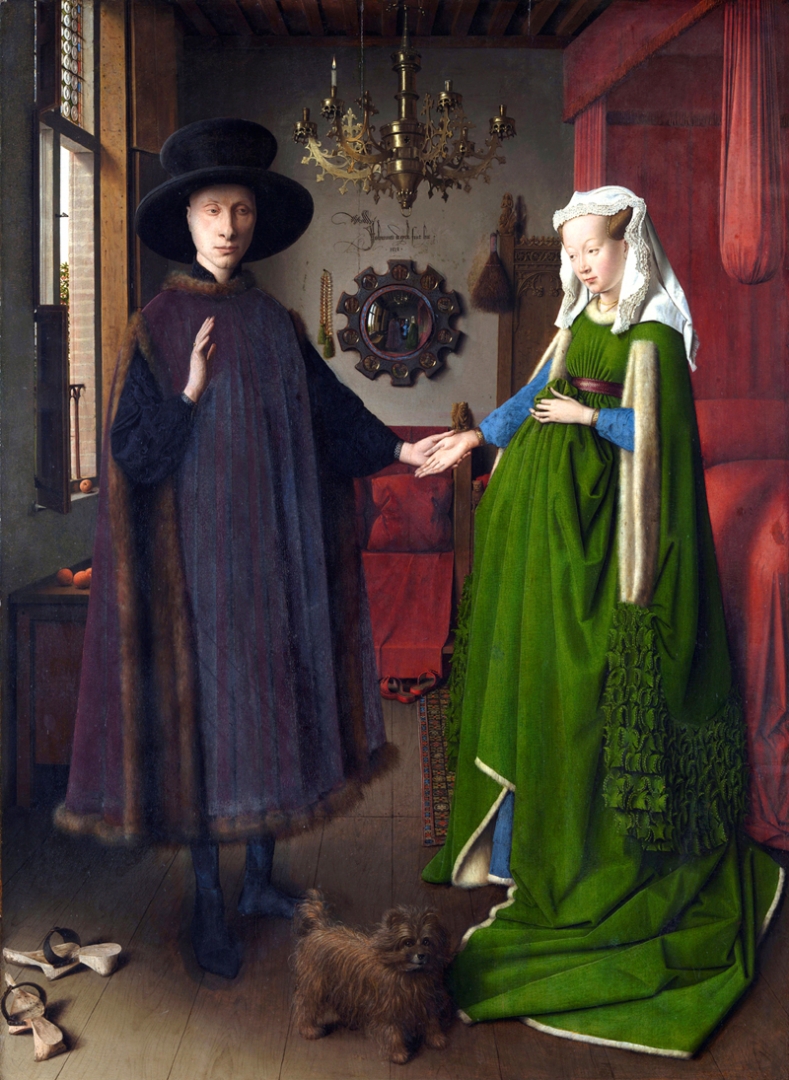
Jan van Eyck painted and documented here, in his extremely realistic and colorful style, an event from everyday life in the city: the marriage of Giovanni Arnolfi.
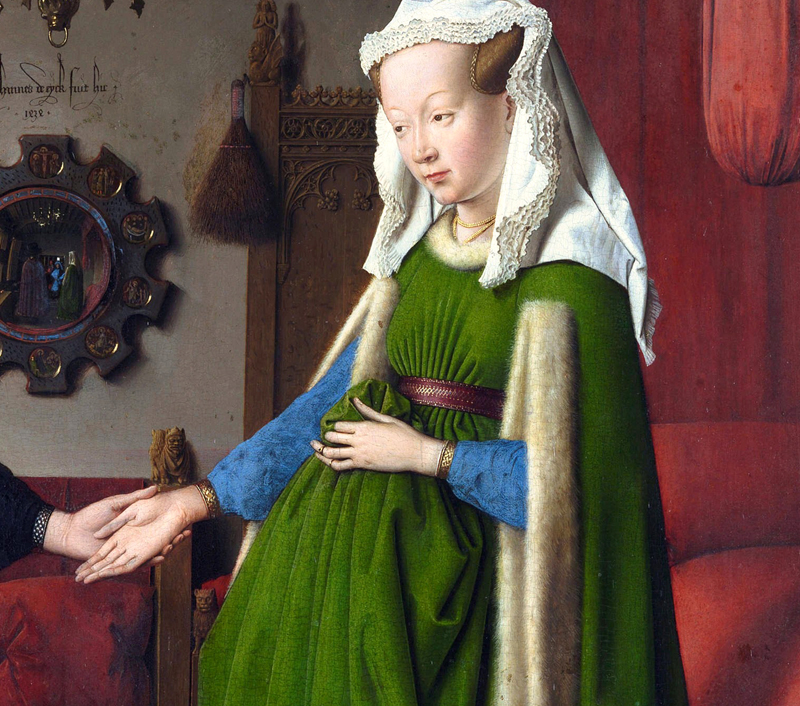
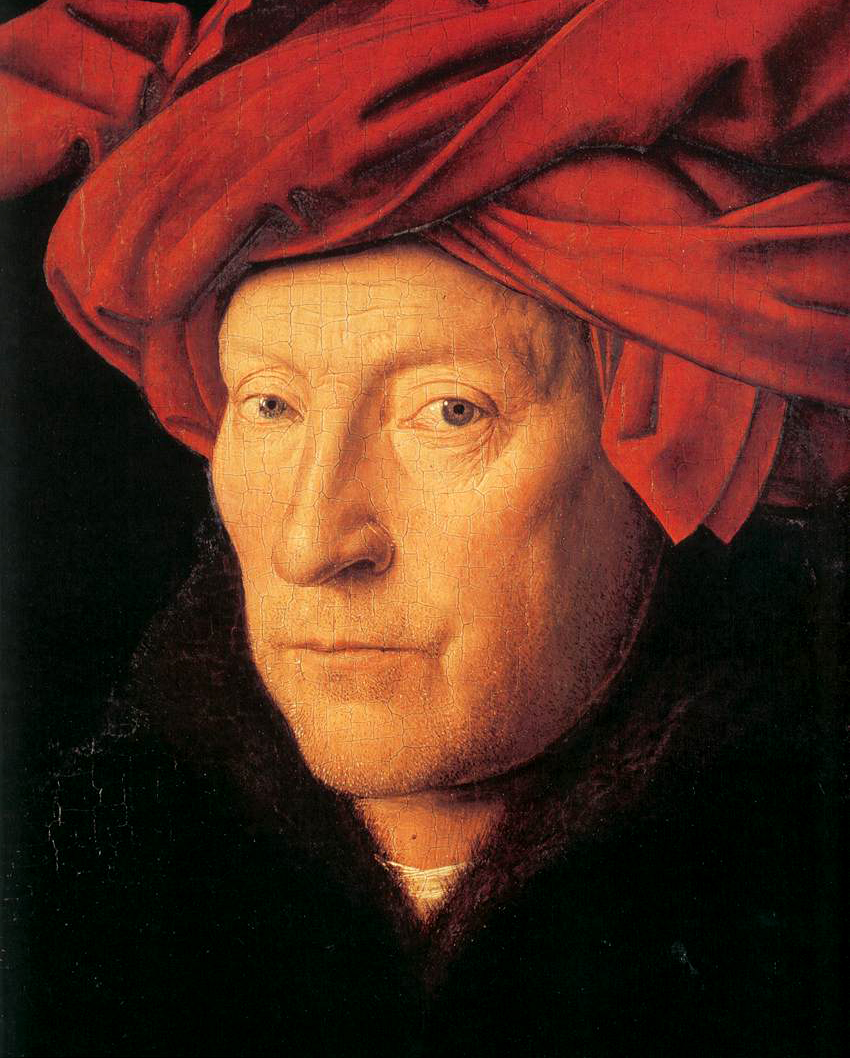
The man wears a cloak resembling a scapular (a shoulder cloth for members of the older order) made of mink fur and a large, wide hat. He is the Italian merchant Arnolfi, who ran Marco Guidecom's Lucchese company in Bruges, the city where Jan van Eyck lived and worked. We know from documents that his wife's name was Jeanne (Giovanna) Cenami and that she was born in Paris, but like him, she was of Italian descent.
In this painting, she is dressed in a heavy green robe and reaches out her hand to Arnolfi. He holds his right hand raised in what could be a blessing, but may also be the gesture used when taking an oath, known as fides lavata. Arnolfi looks at the viewer, although his gaze is averted. Giovanna Cenami's eyes are humbly downcast.
♦ Diagnosis
Main symptoms: Clothing bunched up around the abdomen.
Secondary symptoms: Young woman in fashionable wedding dress.
Clinical diagnosis: Pseudopregnancy
♦ Discussion
Arnolfi's bride is most likely not pregnant. She is holding the fur-trimmed front of her dress tightly in front of her stomach. Some art critics have concluded from this that the swollen contours of her stomach indicate pregnancy.
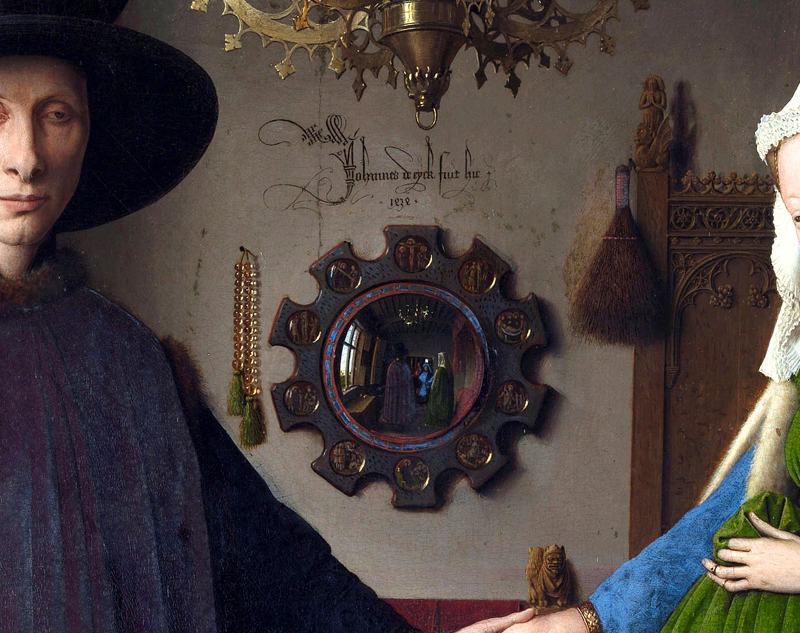
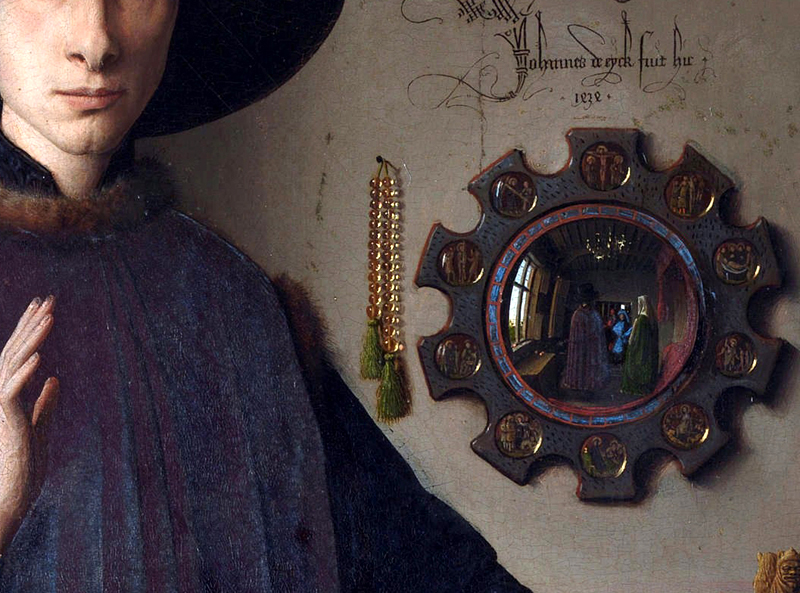
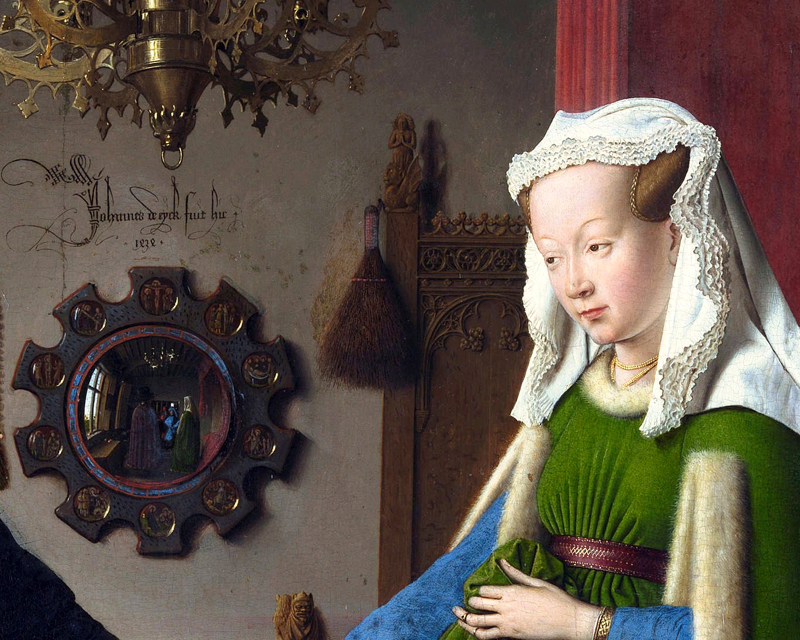
However, this is nothing more than a ritual gesture, entirely in keeping with the conventional views of the time regarding family and marriage and intended to symbolize fertility. After all, this is the couple's wedding portrait. The painting is the visual representation of that event and also served as a marriage certificate, as it proves the painter's attention to that event and his testimony through the inscription on the back wall: ‘Johannes de Eyck fuit hic’ (‘Jan van Eyck made this’).
Er is trouwens nog een tweede bewijs van die getuigenis, gereflecteerd in de bolle spiegel aan dezelfde muur. De spiegel toont de hele kamer en is omzoomd met 10 tafereeltjes uit de passie van Christus. Het gebruik van een inscriptie illustreert de groeiende nood van geschreven bewijzen van legale transacties, een ontwikkeling die samenging met de aanvaarding van de Romeinse wet. Je mag deze inscriptie dus niet uitleggen als louter een signatuur. Het heeft kracht van getuigenis, net als een handtekening in een officieel register.
In the 13th century, it was still customary for the bride and groom to promise each other marital fidelity without the presence of a priest as an official witness. The ‘dextrarum junctio’—holding each other's right hands—and the groom's solemn promise were considered a legal commitment.
It is noteworthy that Arnolfi offers his left hand here. This could indicate that it is a morganatic marriage (also known as a ‘left-hand marriage’) between two partners of unequal status, which had a number of consequences for inheritance and succession rights.
Van Eyck depicted this bourgeois interior with its wooden floor as a thalamus, a bridal chamber, to which he added a number of symbolic objects with either a hidden meaning or a theological or moral commentary on the event.
Thus, the everyday convex mirror becomes a ‘speculum sine macula’ (an immaculate mirror), referring to the purity of the bride, who, according to treatises of the time, was also expected to remain chaste as a married woman.
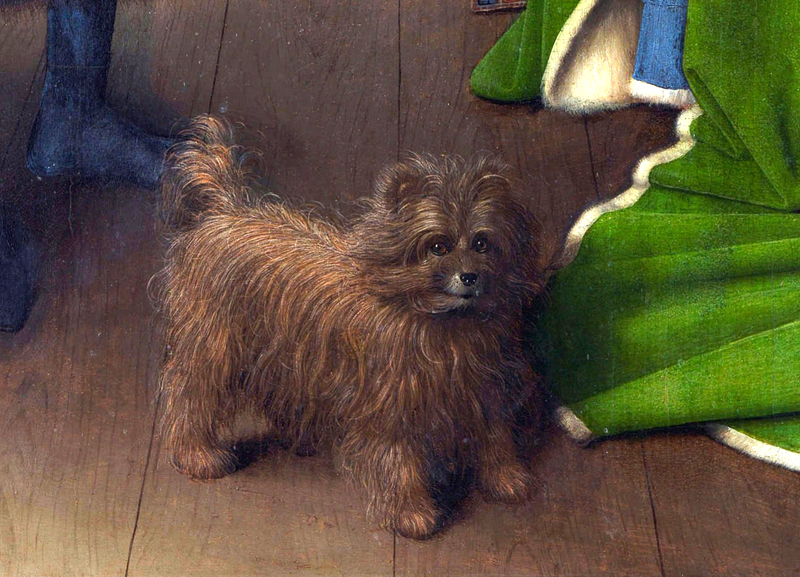
The dog in the foreground—always a symbol of devotion—represents marital fidelity.
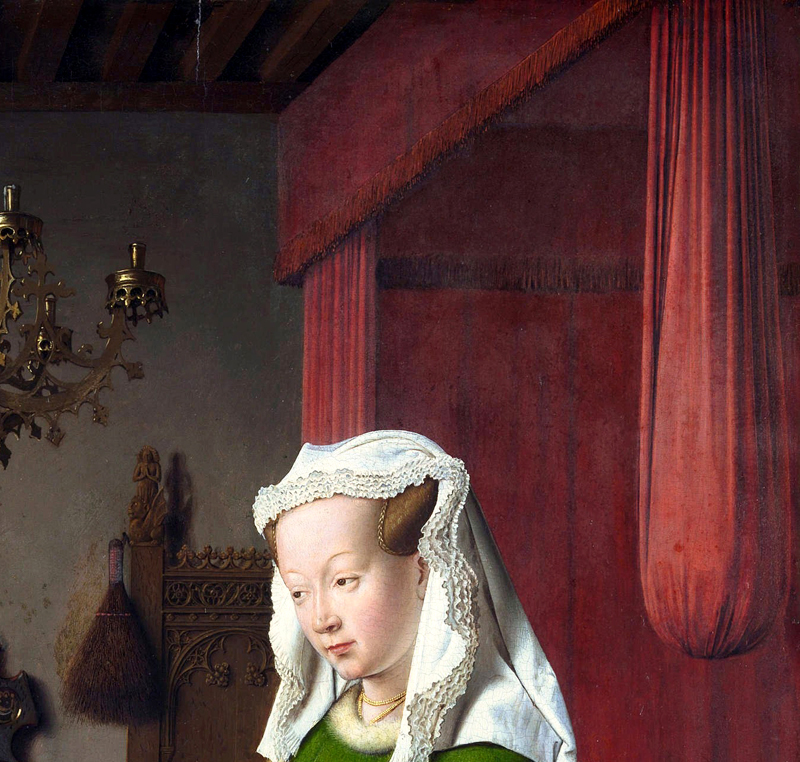
The red alcove on the right—a reference to the Song of Solomon—symbolizes the bridal chamber.
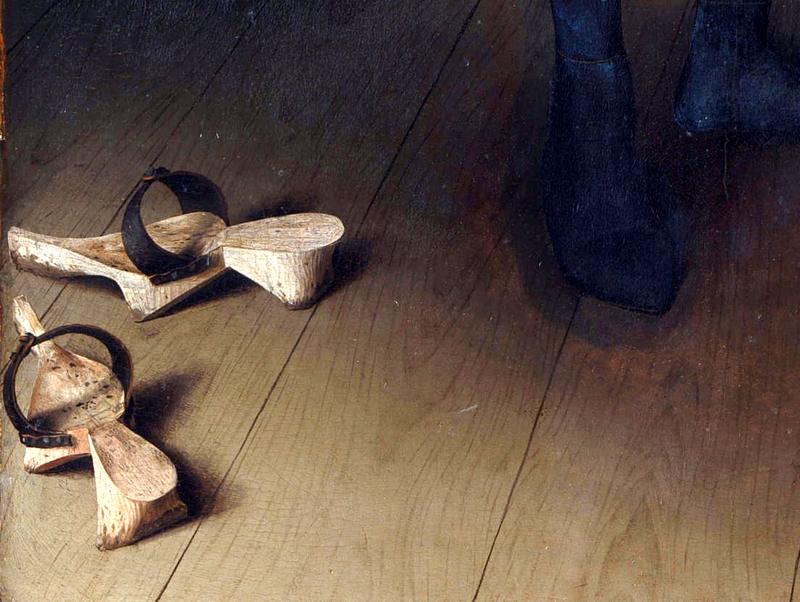
The cork clogs on the left – the groom has just stepped out of them and left them behind – refer to the biblical book of Exodus: ‘Take off your shoes, for the place where you are standing is holy ground’ (Exodus 3:5).
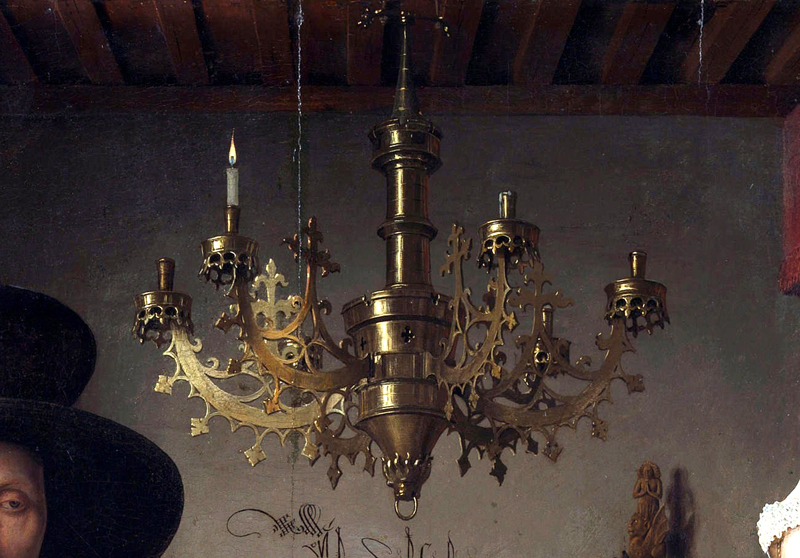
The burning candle in the candlestick – a wedding candle – seems to refer to the iconography of the Annunciation.
It underlines the Mariological character of the painting. Especially for women, the veneration of Mary was an essential factor in 15th-century marriage customs.
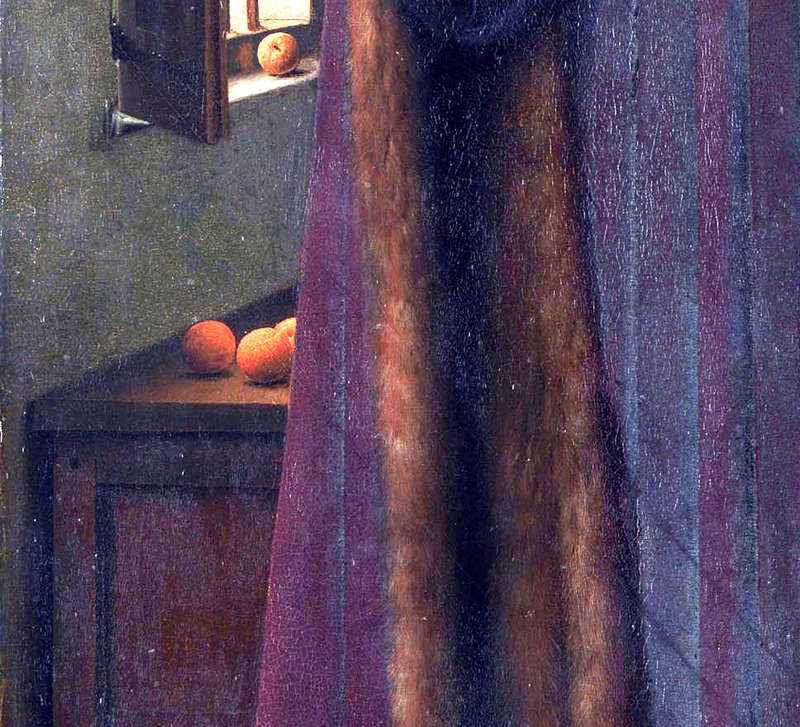
The apples on the windowsill allude to the Fall and warn against sinful behavior.
A set of glass prayer beads hangs on the back wall. Such beads were a typical gift from a forward-thinking husband to his beloved wife. They were intended as a symbol of his wish that his wife remain calm and devout.
Women were also expected to take care of the household, which is why there is a brush hanging on the wall next to the box bed. It symbolizes ‘Ora et labora’ (‘Pray and work’), the daily task of a Christian.
The bed is decorated with a sculpture of Saint Margaret, the patron saint of childbirth.
Source: Jan Dequeker

Pseudopregnancy
References
Jan Dequeker
The artist and the doctor look at paintings
Photos
wikipedia.org
Art lijst
Schilderijen
- Bosch, Hieronymus – The Peddler
- Bosch, Hieronymus_The Haywain triptych
- Botticelli, Sandro_Primavera / Spring
- Brueghel the Elder, Pieter – The Tower of Babel
- Campin, Robert — Mérode Triptych
- Courbet, Gustave_The painters Studio
- Dali, Salvadore_The Temptation of Saint Anthony
- Dou, Gerard_the Quack Doctor
- Eyck van Barthélemy_Still life with books
- Fra Angelico_Annunciation
- Géricault, Théodore_Medusas raft
- Magritte, Rene_Prohibited to depict
- Matsys, Quinten_The money changer and his wife
- Memling, Hans_Two horses in a landscape
- Picasso, Pablo_Guernica
- Rembrandt_Abraham and the Three Angels
- Rembrandt_Elsje Christiaens
- Unknown – 16th century: Four depictions of a physician
- Velazquez, Diego_Las Meninas
Schilderijen en de dokter
- Agenesia Sacrale (a rare congenital disorder in which the fetal development of the lower spine)
- Alopecia areata (hair loss)
- Arthrogryposis congenita (birth defect, joints contracted)
- Artritis psoriatica (inflammatory disease of the joint)
- Artritis reumatoïde
- Breast development (delayed)
- Bubonic plague
- Dental caries
- Diphtheria
- Extraction of the Stone of Madness
- Eye surgery
- Flat foot and Pointed Foot
- Fungal disease_Favus
- Gigantism and Acromegaly
- Goiter (struma)
- Hare lip (cheiloschisis) / cleft palate
- Herpes zoster (shingles)
- Hunger edema
- Influenza Epidemic of 1858
- Insanity - Malle Babbe (1640)
- Leprosy
- Lovesick, pregnancy
- Lymph node tumor (lymphoma), non-Hodgkin
- Manic Depression Psychosis
- Measles / Rubella? (acute viral infection)
- Melanoma or nevus (birthmark)
- Membranous glomerulonephritis
- Murder (pneumothorax, arterial bleeding)
- Neurofibromatosis
- Osteoarthritis / hallux valgus
- Osteomyelitis
- Otitis media (acute middle ear infection)
- Parotitis (mumps)
- Polio
- Prepatellar bursitis
- Progeria
- Pseudohermafroditism
- Pseudopregnancy
- Psychoneurosis (acute)
- Pulmonary tuberculosis
- Rachitic chest
- Rheumatic fever (acute)
- Rhinophyma and rosacea_depression
- Rhinophyma or bulbous nose
- Rhinoscleroma
- Syphilis (hard chancre)
- Ziekte van Paget
Schilders
Historie lijst
- 1632-1723_Antonie van Leeuwenhoek
- 1749-1823_Edward Jenner
- 1818-1865_Ignaz Semmelweis
- 1822-1895_Louis Pasteur
Wetenswaardigheden lijst
- 1887 Psychiatric Hospital
- Animals on duty
- Bizarre advice for parents
- Bloodletting
- Bloodthirsty Hungarian Countess Elizabeth Báthory (1560–1614)
- Butler escaped punishment three times.
- Dance mania / Saint Vitus Dance
- Doctors’ advice did more harm than good
- French Revolution Louis XVI
- Frontal syndrome (Phineas Gage)
- Heart disease (Egyptian princess)
- Ice Age (minor)_1300-1850
- Ivan IV de Verschrikkelijke (1530-1584)
- Kindermishandeling
- Koketteren met koningin Victoria
- Koningin door huidcrème vergiftigd
- Kraambedpsychose (Margery Kempe)
- Massacre in Beirut
- ME stonden bol van de seks
- Mummie bij de dokter
- Plee, Gemak of Kakstoel
- Prostaatkanker (mummie)
- Sexhandel in Londen
- Swaddling baby
- Syfilis was in de mode
- Testikels opofferen
- Tropische ziekten werden veroveraars fataal
- Vrouwen als beul in WOII
- Wie mooi wil zijn moet pijn lijden
- Zonnekoning woonde in een zwijnenstal