.jpg)

.JPG)

.jpg)
Quinten Metsijs
1465, Leuven – 1530, Antwerp, Belgium
Metsijs was born in Leuven and completed his apprenticeship under the influence of Bouts.
We don't know if he also traveled to Italy to study art, as was customary at the time.
His work, which is rooted in Flemish traditions, does, however, show Italian influences, particularly those of Leonardo da Vinci.
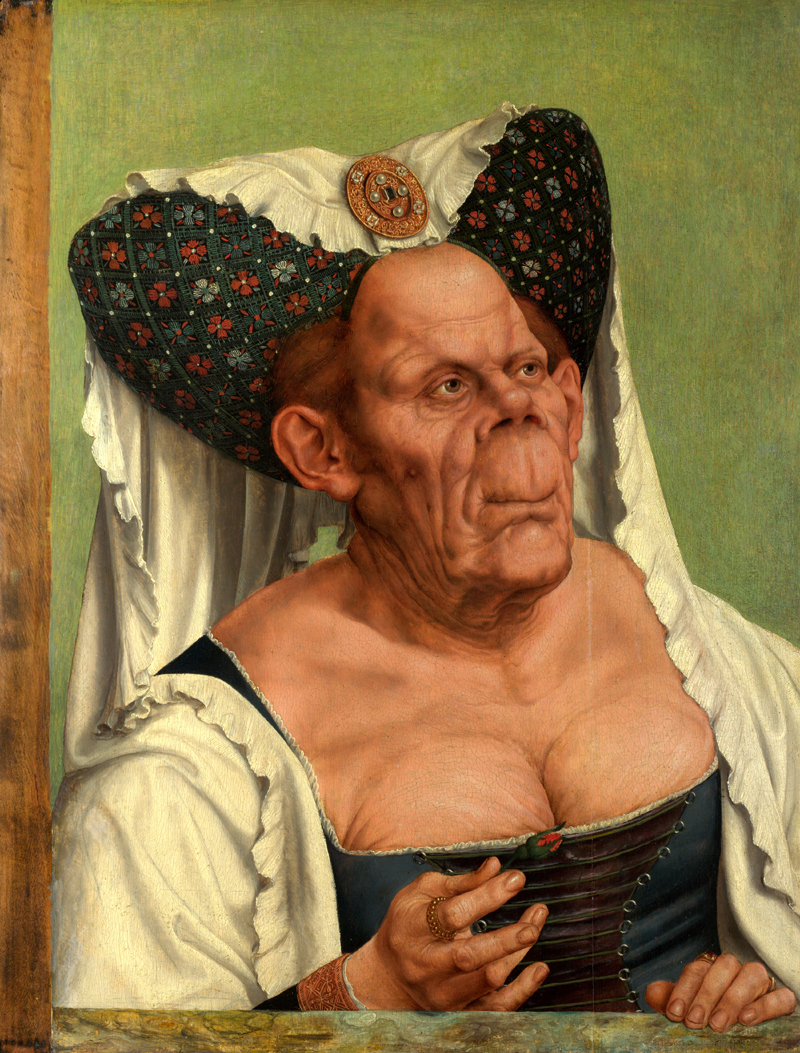
♦ Grotesque old woman ♦
This painting depicts an elderly woman holding a rosebud between her fingers.
She is wearing a dress with a low-cut neckline and an Italian-style headpiece.
The realism of every detail and the caricature-like face are astonishing.
♦ Diagnosis
Main symptoms: ‘Facies leotina’ (lion-like face), broad, coarse nose, enlarged jaw.
Secondary symptoms: Female, elderly, well-dressed, hypertrophy and curvature of the right clavicle, skin tag.
Clinical diagnosis: Paget’s disease
♦ Definition: Paget's disease
Paget's disease is a localized bone disorder of unknown cause characterized by significantly increased bone formation and resorption.
♦ Discussion
This woman’s ugly face is painfully accurate, painted with precision and fluidity, capturing all its deformities, abnormalities, and distortions.
The nostrils, for example, are strange, wide open, and excessively curved. The width of the cheeks is further emphasized by the ears, which stand out sharply from the head. De ruimte onder de neus puilt uit. The broad, high cheekbones and the large, coarse nose give the face an open, snorting expression that is somewhat reminiscent of a wild animal—say, a lion.
Clinicians refer to this characteristic facial appearance as facies leotina, or “lion's mouth.”
The facial deformities in the woman in the painting can be explained by hypertrophy of the jawbones. These features give the face a prominent upper lip and a raised nose and nostrils. It is also possible that the chin has grown abnormally large, because otherwise it would have receded as a result of the enlarged jawbones.
A skin tag on the right cheek is clearly visible. The right collarbone is curved and enlarged.
Hypertrophy of the upper and lower jaws and the clavicle is characteristic of bone changes resulting from Paget's disease.
♦ Portrait or caricature?
Although this artwork seems to clearly refer to an ancient disease, it is very difficult to interpret.
It is easy to make a diagnostic error, whether by diagnosing a nonexistent disease or by interpreting what at first glance appears to be a pathological finding but is in fact nothing more than the expression of an artistic convention. (1);
When Alistair Smith commented on this painting, he stated that “it seems highly unlikely that this painting was painted from life.” (2);
He claims that, at the time it was painted during Metsijs’s later years, there was a strong tendency toward caricature and satire, which was particularly prevalent in the visual arts in northern Europe. This genre was primarily found in woodcuts that commented on events of the time. That is why it is quite unusual to find it in a painting, a medium whose formal status typically precluded such subjects.
The fact that the woman is holding a rosebud between her fingers—traditionally a symbol of early youth or budding love—stands in stark contrast to her appearance.
Perhaps this suggests that the painter intended to depict an elderly woman who was overly concerned with her appearance, either to entertain his viewers or to present a satire.
He may have been inspired to do so by the book *In Praise of Folly* by his friend Erasmus, who describes old women in it as “still flirting,” “inseparable from mirrors,” and “not hesitating for a moment to display their repulsively sagging breasts.”
This does not necessarily mean that the painter made up his model. He may well have used a real model. A “lion’s mouth” (facies leontina) is such a grotesque deformity that the painter could not possibly have forgotten it once he had seen it.
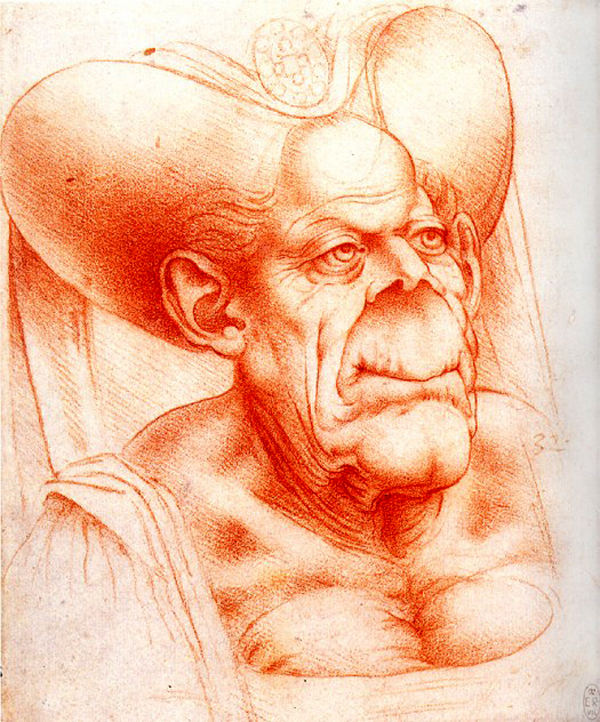
It is possible that a drawing by Leonardo da Vinci served as the direct source for this painting. (3);
The drawing, a replica of the one kept at Windsor Castle, was copied almost exactly by Metsijs. The painter added only a few details, such as the lacework and the pattern on the headdress, the corset, the striking hands holding the rosebud, and the balustrade, which further accentuates the caricatured nature of the elderly, self-indulgent woman..
The important point here is that Metsijs apparently had access to the drawings (or the replica), which he copied meticulously.
This wasn't the first time Metsijs had borrowed from a drawing by Leonardo.
In at least two separate instances, he copied heads from da Vinci’s famous study of five grotesque heads, notably in his *Martyrdom of John the Evangelist* (1508–1511), a triptych (Royal Museum of Fine Arts, Antwerp), and in his painting *Ill-Matched Lovers* (National Gallery of Art, Washington).
The grotesque figures in Leonardo’s drawings resemble the eccentrics one sometimes sees on the fringes of society, and for that reason they are most likely portraits from life. Their faces reveal various pathological symptoms.
The elderly woman (possibly Italian) who was sketched by Leonardo and depicted in Metsijs’s painting may have had Paget’s disease. He may have painted that grotesque old lady to mock the members of the Florentine merchant community in Antwerp, who were known for their usurious interest rates and their stinginess.
Because of its grotesque and caricature-like nature, this print continued to appear in engravings for a long time, such as in this one by Wenzel Hollar (1607–1677) titled *The King and Queen of Tunis*.
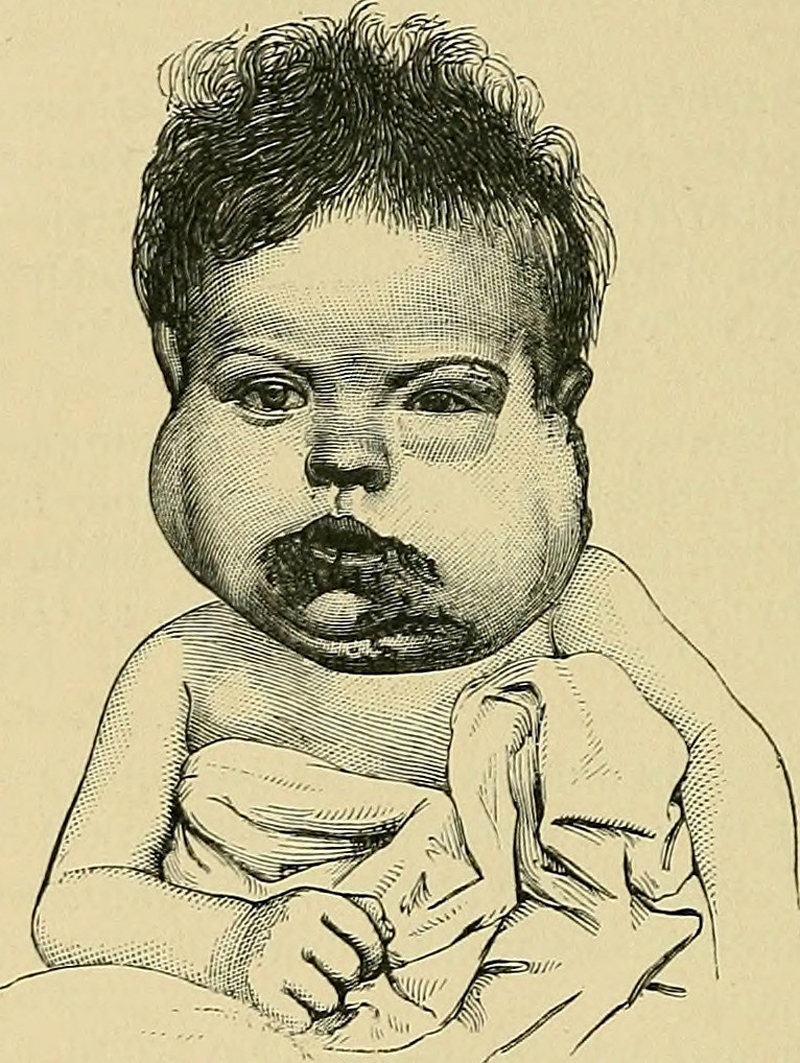
The jaw and facial bones are rarely affected by Paget's disease, and when they are, it is usually at a young age (4);
The facial deformities, characterized by excessively protruding cheeks and a lion-like mouth, are caused by the jawbones protruding forward. The enlargement of the jawbones and the hardening of the palate can cause problems with speaking, chewing, or swallowing.
If the enlargement occurs gradually, patients and their relatives are often unaware of the deformity that has developed.
Paget's disease of the jaw is usually first noticed by a dentist, for example because a tooth is difficult to extract or because dentures never seem to fit for more than a few months.
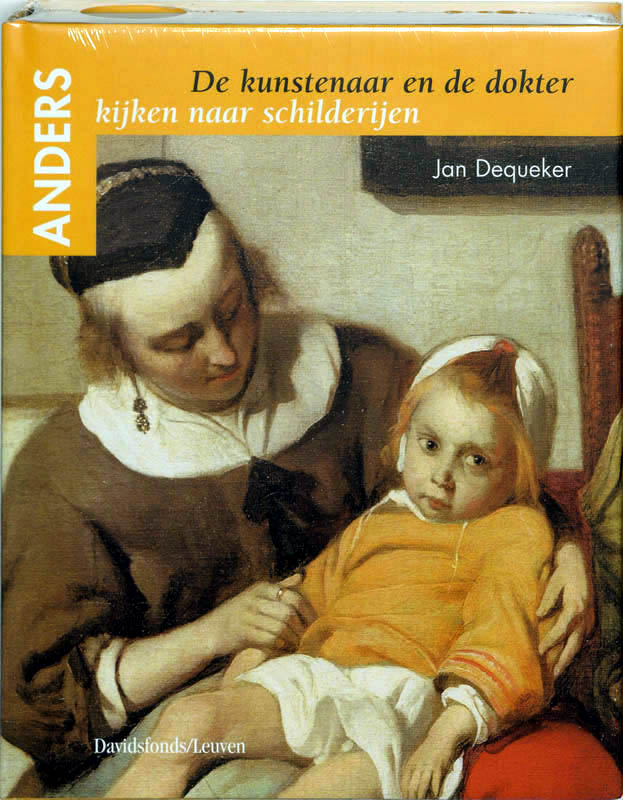
Source: Jan Dequeker—The Artist and the Doctor Look at Paintings
(1); Dequeker J., Paget's disease in a painting by Quinten Metsijs (Massys). Brit. Med. J. 1989; 299: 1579-81.
(2); Smith A., Early netherlands and German paintings. The national gallery schools of painting. London, Collins, 1985.
(3); Silver L., Power and Pelf: a new found old men by Massys. Simiolus 1977; 9: 63-92
(4); Hamdy R.C., Paget's disease of bone: assesment and management. Eastbourne, Armour Pharmaceutical, 1981

Paget's disease
References
Jan Dequeker
The Artist and the Doctor Look at Paintings
Photo's
wikipedia.org In Praise of Folly_Erasmus
https://www.bol.com/nl/p/lof-der-zotheid/9200000019505034/