.jpeg)
Vincent van Gogh
30-3-1853, Zundert, Ned - 27-7-1890, Auvers-sur-Oise, France
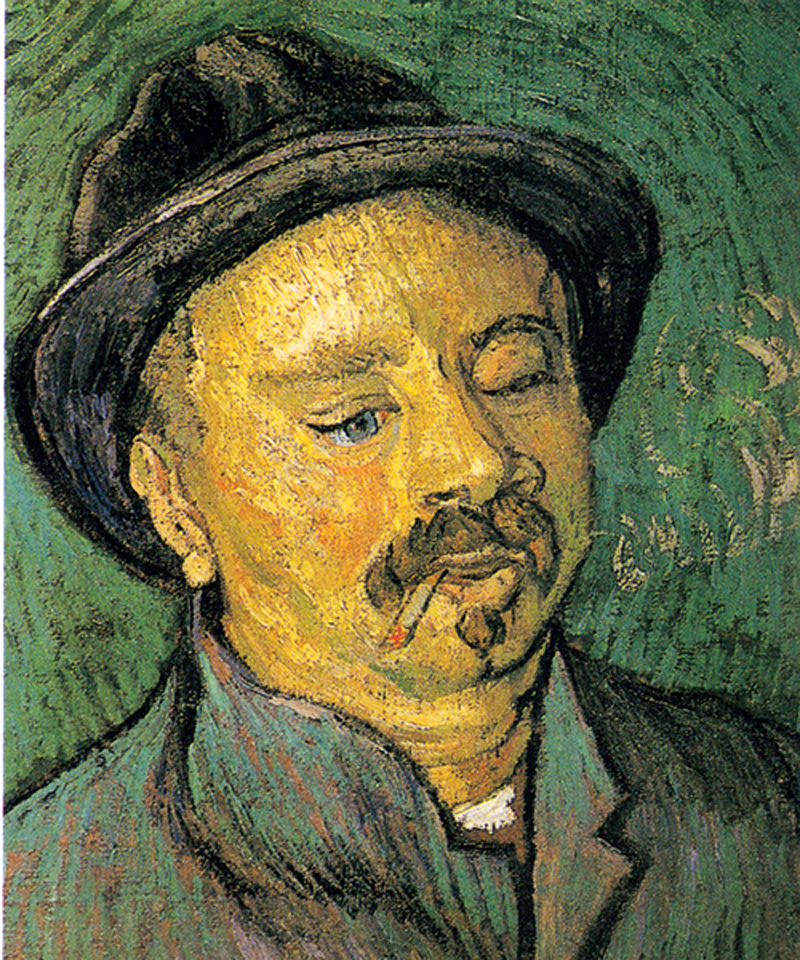
♦ The one-eyed person with a swollen face ♦
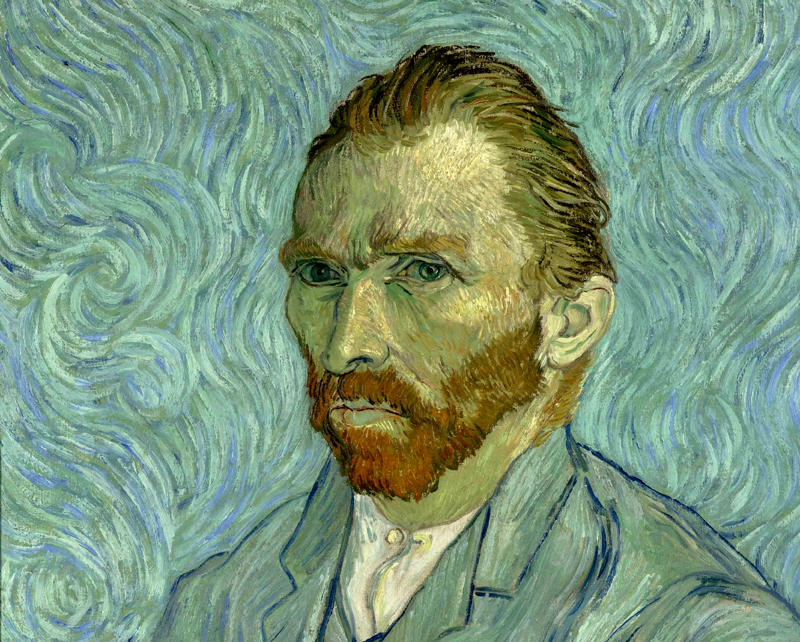
Portrait of a Man with One Eye. The One-Eyed Man with the Swollen Face (1888) was made when Van Gogh was admitted to a mental institution.
♦ Diagnosis:
Main symptoms: a swollen left upper eyelid, which pushes the eyebrow upward and closes the eye
♦ Clinical diagnosis:
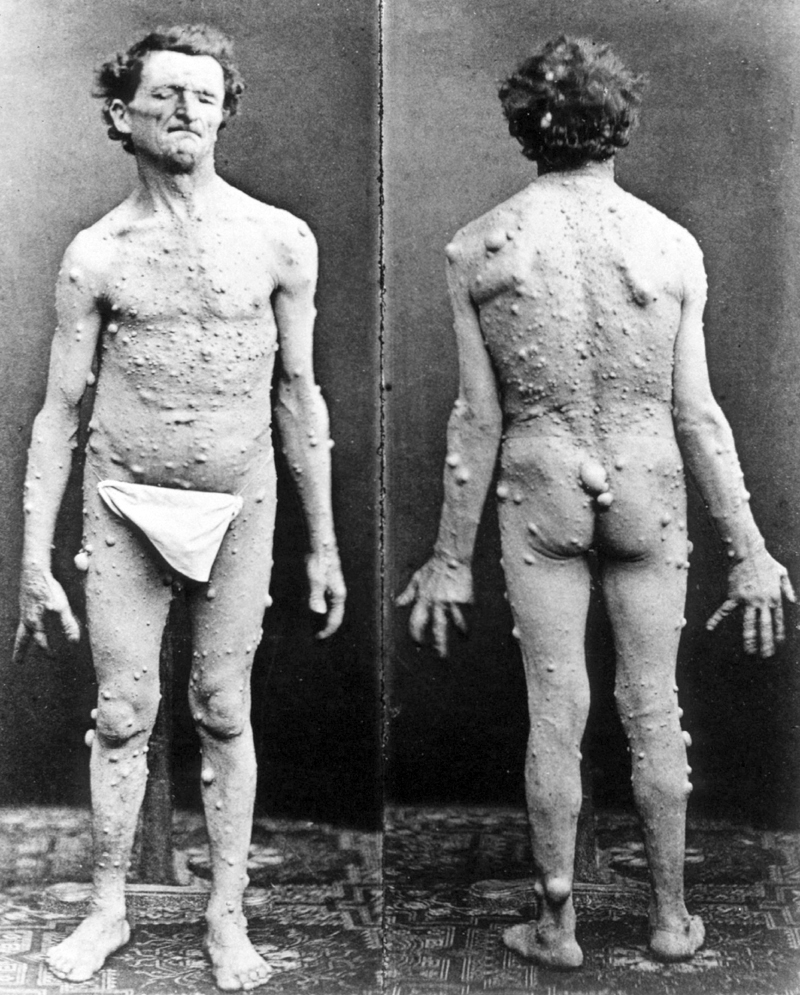
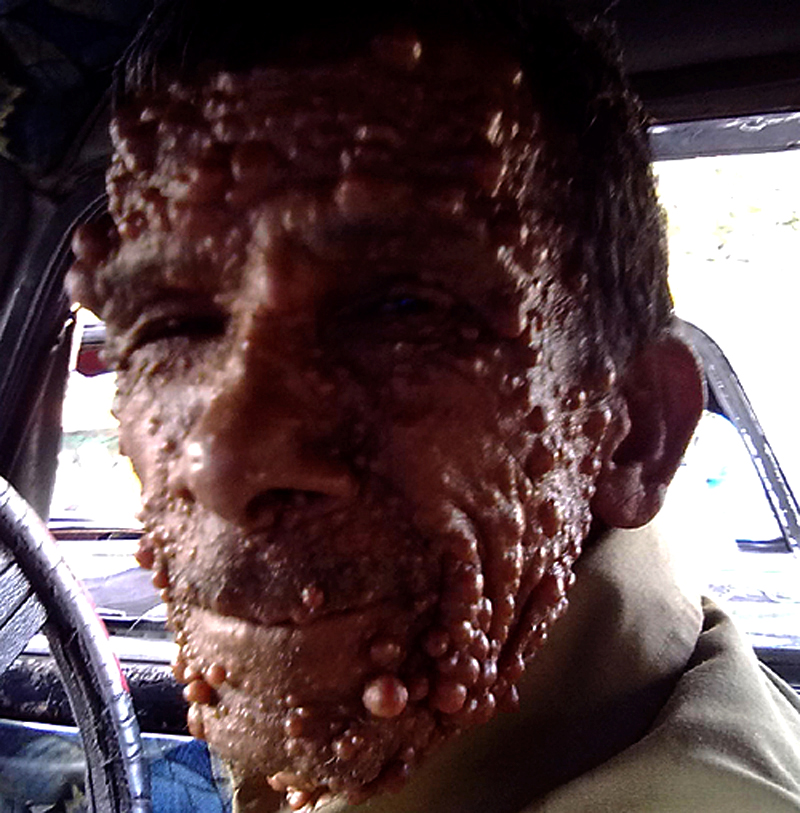
Neurofibromatosis, Recklinghausen disease ♦ Definition: neurofibromatosis
The disease is characterized by the presence of tumors (neurofibromas) in or under the skin, originating from the cutaneous nerves. They are usually benign, although malignant ones do occasionally occur. The disease is likely hereditary.
♦ Discussion:
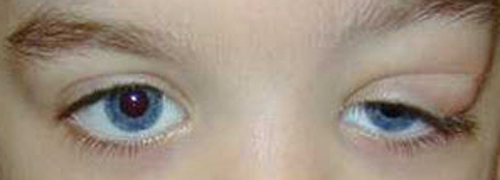
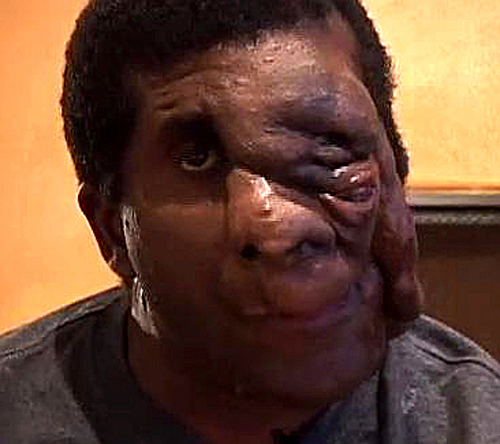
Neurofibromas occur both on the eyelids and in the eye sockets. Normally, the temples are also affected, but the left temple region is not visible in this painting. In the lower image, you see a contemporary patient in whom both the eye and the skin are affected by neurofibromatosis.
Source: Jan Dequeker
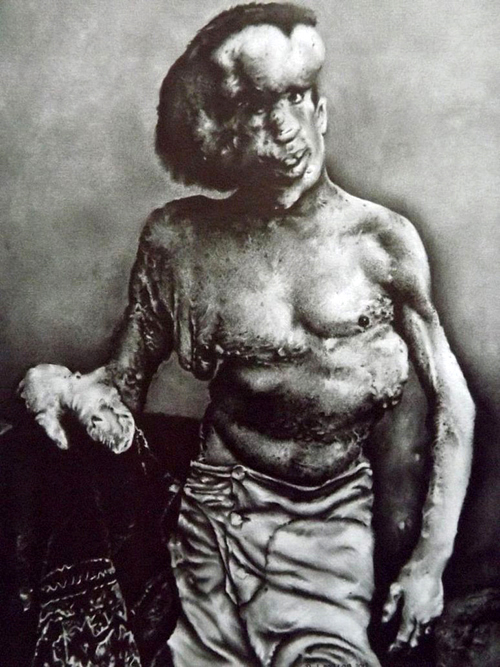
The most famous personwith neurofibromatosis (especially Proteus-syndroom)
♦ is: John Merrick the elephant man
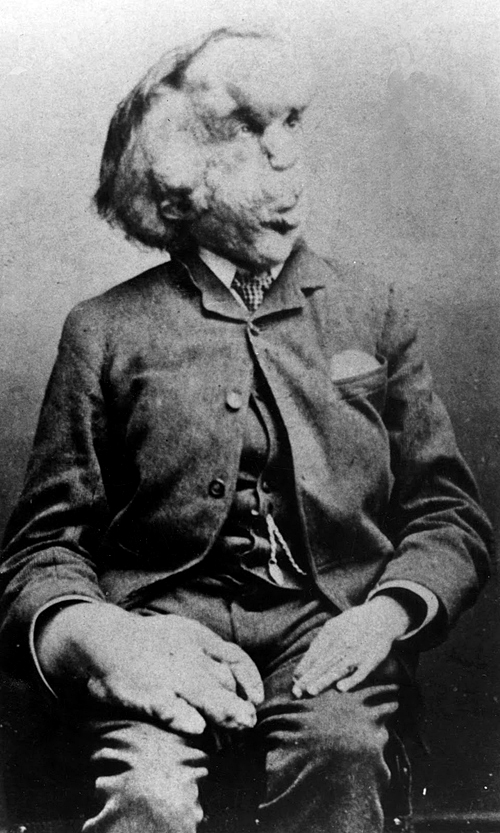
Joseph Joseph Merrick, also known as “The Elephant Man.”
Joseph Carey Merrick (Leicester, 5 August 1862 – London, 11 April 1890) was an Englishman who became known because of his abnormal physical appearance. This was later classified as Proteus syndrome, and it is possible that he also suffered from neurofibromatosis
♦ Biography
Merrick’s parents were Joseph Rockley Merrick and Mary Jane Potterton. At the beginning of his life, he looked like an ordinary boy, but between the ages of three and five, this changed. Lumps began to grow on the right side of his face and body, and this progressed rapidly.
The doctors who examined him assumed that he suffered from the rare condition elephantiasis.
Because of his deformities, Merrick was isolated from normal interaction with other children and could hardly attend school anymore, as he was weak and bullied. He was too frightening for most people to look at.
The doctors could do nothing for him, and Merrick was soon rejected by those around him.
According to various sources, his parents are said to have completely rejected him when he was ten years old. This is not entirely correct. His mother never rejected him, but died when Merrick was twelve years old. He was left in the care of his father, who remarried.
Merrick’s stepmother did not accept him and insisted that the child be turned out of the house. As a result, Merrick began to wander the streets and tried to earn money as a shoeshiner. He was bullied and mocked in the streets because of his frightening appearance. Much of Merrick’s face and body were overgrown with hard bone tumors. Curious people often gathered around him to stare. Merrick eventually decided to work as a curiosity in a circus “freak show,” where he attracted many visitors.
Later, he himself wrote that the time he had worked as a curiosity for the circus had been less painful for him than his life in the ordinary world. At the circus, people had been exceptionally kind to him. The money Merrick earned there he saved, but it was stolen from him in Belgium by a con artist.
Merrick returned to England destitute and distressed. There, he was harassed by people, beaten, and ended up in the hospital.
The police found a card addressed to Dr. Frederick Treves in his pocket. A few years earlier, Dr. Frederick Treves had met Merrick at one of his circus performances. The surgeon had shown interest in his condition and had given him his address in London. Now Merrick came back into contact with Dr. Treves. The doctor offered Merrick shelter in a hospital in Whitechapel.
♦ Frederick Treves
Treves made the (incidentally incorrect) diagnosis of “elephantiasis” in Merrick’s case. Dr. Treves collected donations to pay Merrick’s hospital expenses. The press also took an interest in Merrick, and he began to gain some notoriety. Merrick once again became a curiosity, but this time for wealthier people, who treated him with more respect. Even members of the royal family came to “view” him.
When he had free time, Merrick could not simply walk the streets, as he would then be attacked and verbally abused. For this reason, he wore a hood specially made for his enormous head to hide his appearance. He was a sensitive man who understandably suffered greatly from his deformity.
In 1889, he took a six-week holiday and went into nature, far away from the curious stares of people. His health deteriorated as his deformities continued to increase.
♦ Death
Merrick had had to sleep upright for almost his entire life because his head was so heavy that, when lying flat, he could not get enough air. On 11 April 1890, he was found dead in his bed. It was unclear whether he had deliberately lain flat in order to die, or whether it was an accident. Merrick was 27 years old. After his death, his body was on display for some time at the Royal Hospital in London.
♦ Name
He was given the nickname The Elephant Man because he suffered from severe deformities over almost his entire body. Initially, doctors believed that Merrick had elephantiasis. Long after Merrick’s death, the suggestion arose that he may have suffered from neurofibromatosis. In 1986, it was proposed that his condition was the rare Proteus syndrome. In 2003, Dr. Charis Eng announced that, according to DNA research, Merrick definitely had Proteus syndrome, but that it was quite possible that he also had neurofibromatosis (type 1)

Neurofibromatosis
References
Jan Dequeker
The artist and the doctor
Photos
WikimediaCommons
Wikipedia.org
Art lijst
Schilderijen
- Bosch, Hieronymus – The Peddler
- Bosch, Hieronymus_The Haywain triptych
- Botticelli, Sandro_Primavera / Spring
- Brueghel the Elder, Pieter – The Tower of Babel
- Campin, Robert — Mérode Triptych
- Courbet, Gustave_The painters Studio
- Dali, Salvadore_The Temptation of Saint Anthony
- Dou, Gerard_the Quack Doctor
- Eyck van Barthélemy_Still life with books
- Fra Angelico_Annunciation
- Géricault, Théodore_Medusas raft
- Magritte, Rene_Prohibited to depict
- Matsys, Quinten_The money changer and his wife
- Memling, Hans_Two horses in a landscape
- Picasso, Pablo_Guernica
- Rembrandt_Abraham and the Three Angels
- Rembrandt_Elsje Christiaens
- Unknown – 16th century: Four depictions of a physician
- Velazquez, Diego_Las Meninas
Schilderijen en de dokter
- Agenesia Sacrale (a rare congenital disorder in which the fetal development of the lower spine)
- Alopecia areata (hair loss)
- Arthrogryposis congenita (birth defect, joints contracted)
- Artritis psoriatica (inflammatory disease of the joint)
- Artritis reumatoïde
- Breast development (delayed)
- Bubonic plague
- Dental caries
- Diphtheria
- Extraction of the Stone of Madness
- Eye surgery
- Flat foot and Pointed Foot
- Fungal disease_Favus
- Gigantism and Acromegaly
- Goiter (struma)
- Hare lip (cheiloschisis) / cleft palate
- Herpes zoster (shingles)
- Hunger edema
- Influenza Epidemic of 1858
- Insanity - Malle Babbe (1640)
- Leprosy
- Lovesick, pregnancy
- Lymph node tumor (lymphoma), non-Hodgkin
- Manic Depression Psychosis
- Measles / Rubella? (acute viral infection)
- Melanoma or nevus (birthmark)
- Membranous glomerulonephritis
- Murder (pneumothorax, arterial bleeding)
- Neurofibromatosis
- Osteoarthritis / hallux valgus
- Osteomyelitis
- Otitis media (acute middle ear infection)
- Parotitis (mumps)
- Polio
- Prepatellar bursitis
- Progeria
- Pseudohermafroditism
- Pseudopregnancy
- Psychoneurosis (acute)
- Pulmonary tuberculosis
- Rachitic chest
- Rheumatic fever (acute)
- Rhinophyma and rosacea_depression
- Rhinophyma or bulbous nose
- Rhinoscleroma
- Syphilis (hard chancre)
- Ziekte van Paget
Schilders
Historie lijst
- 1632-1723_Antonie van Leeuwenhoek
- 1749-1823_Edward Jenner
- 1818-1865_Ignaz Semmelweis
- 1822-1895_Louis Pasteur
Wetenswaardigheden lijst
- 1887 Psychiatric Hospital
- Animals on duty
- Bizarre advice for parents
- Bloodletting
- Bloodthirsty Hungarian Countess Elizabeth Báthory (1560–1614)
- Butler escaped punishment three times.
- Dance mania / Saint Vitus Dance
- Doctors’ advice did more harm than good
- French Revolution Louis XVI
- Frontal syndrome (Phineas Gage)
- Heart disease (Egyptian princess)
- Ice Age (minor)_1300-1850
- Ivan IV de Verschrikkelijke (1530-1584)
- Kindermishandeling
- Koketteren met koningin Victoria
- Koningin door huidcrème vergiftigd
- Kraambedpsychose (Margery Kempe)
- Massacre in Beirut
- ME stonden bol van de seks
- Mummie bij de dokter
- Plee, Gemak of Kakstoel
- Prostaatkanker (mummie)
- Sexhandel in Londen
- Swaddling baby
- Syfilis was in de mode
- Testikels opofferen
- Tropische ziekten werden veroveraars fataal
- Vrouwen als beul in WOII
- Wie mooi wil zijn moet pijn lijden
- Zonnekoning woonde in een zwijnenstal