Jusepe de Ribera
1591, Játiva, Valencia - 1652, Naples, Italy
♦ Magdelena Ventura, the woman with the beard ♦
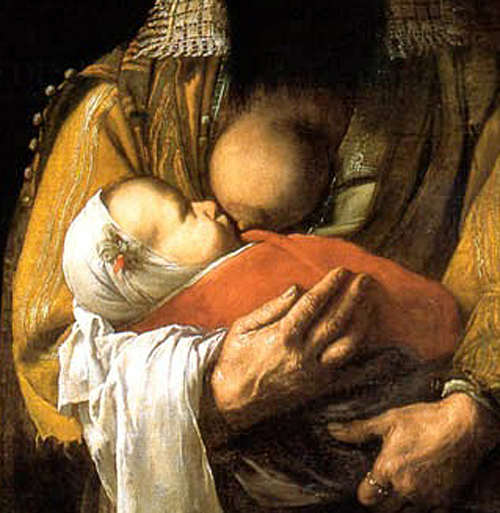
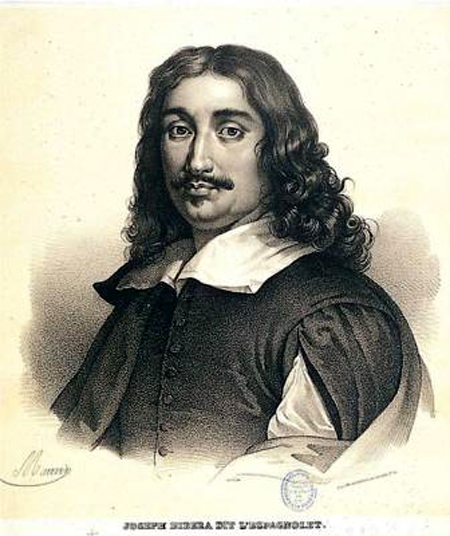
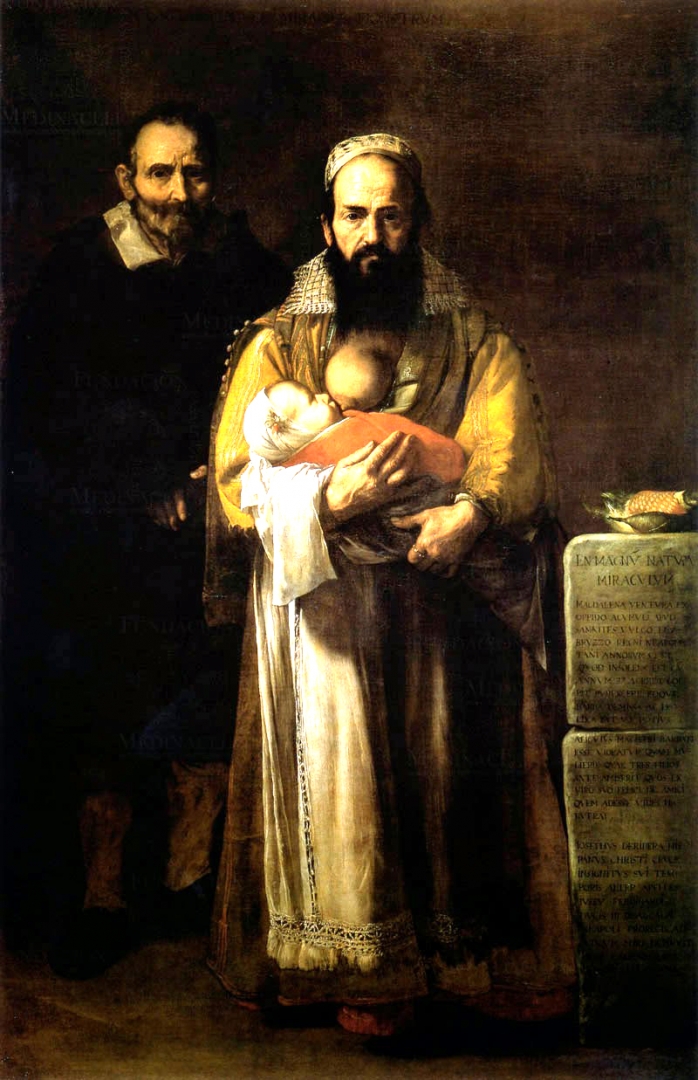
The painting of the bearded woman, Magdelena Ventura, with her husband and child, was commissioned from Jusepe de Ribera in 1631 by Ferdinand II, 3rd Duke of Alcala and Viceroy of Naples.
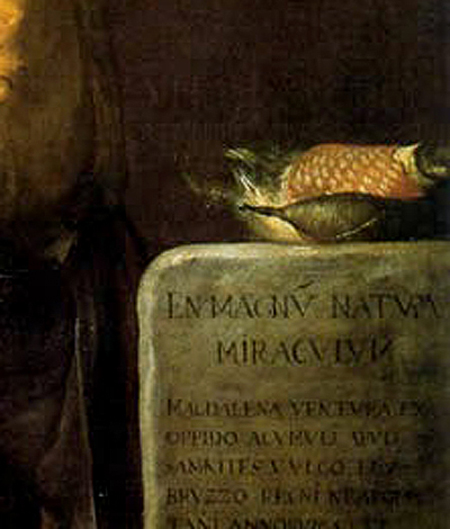
The painting bears an inscription with the following text:
Magdelena Ventura, the great wonder of nature, from the city of Accumole in central Italy, aged 52 years.
♦ Diagnosis:
Main symptoms: long beard, receding hairline, bald forehead
Secondary symptoms: firm, swollen breasts with enlarged areolas
Clinical diagnosis: Adrenogenital syndrome, pseudohermaphroditism
♦ Definition: Adrenogenital syndrome
Adrenogenital syndrome is caused by excessive secretion of androgens in women, who consequently develop male characteristics (virilizing adrenal hyperplasia).
♦ Definition: pseudohermafroditism
A person with congenitally malformed external genitalia resembling one sex, while the gonads belong to the other sex.
♦ Definition: hermafroditism
A condition characterized by the simultaneous presence of ovarian and testicular tissue in a single individual. It is rare in humans but more common in lower life forms. Pseudohermaphroditism, on the other hand, is much more common.
♦ Discussion:
The woman in the painting is Magdelena Ventura, a woman from the Abruzzi region, who at the age of 37, after giving birth to three sons, began to show symptoms of virilization, including the growth of a thick beard.
In 1631, she moved to Naples, where, at the age of 52, she had another child. When the Duke of Alcala learned of this phenomenon, he introduced Magdalena to Ribera and asked him to paint her portrait.
To dispel any doubts about her gender, Magdelena bares her right breast and feeds her daughter.
Next to her stands a pedestal with a spinning wheel and a snail on top; the former refers to
her domestic duties, the latter is a symbol of hermaphroditism. On the pedestal is a Latin text telling the story of Magdelena, which begins with the words: ‘En Magna naturae miraculum’ (behold a great miracle of nature).
The woman and her husband, who stands somewhat mournfully in the background, seem to be begging for pity for their misfortune.
Despite unmistakable signs of virilization—a full beard and a bald forehead—the woman is breastfeeding her child.
In her case, beard growth began at the age of 37. Apparently, the syndrome only manifested itself late in her adult life, so that the function of the ovaries was not disrupted. The adrenal glands are located at the top of the kidneys.
They produce three groups of hormones, stimulated by the pituitary gland in the lower part of the brain. Adrenocortical hormones are classified into three groups according to their metabolic and other effects.
1. glucocorticoids or carbohydrate-regulating corticosteroids
2. mineralocorticoids or sodium-retaining hormones
3. so-called 'sex hormones'
This painting focuses on the latter group. The wide range of steroids secreted by the adrenal cortex reflects to some extent the variety of clinical diseases that arise when something goes wrong with adrenal function.
The clinical manifestations of adrenal gland overproduction in an individual patient depend on the duration of the disorder and the amount and type of steroid hormones or groups of hormones produced.
Congenital adrenal hyperactivity, postnatal tumors, or hyperplasia can cause female pseudohermaphroditism in girls. The clitoris becomes larger and may resemble a penis.
♦ Hermafroditism and pseudohermafroditism
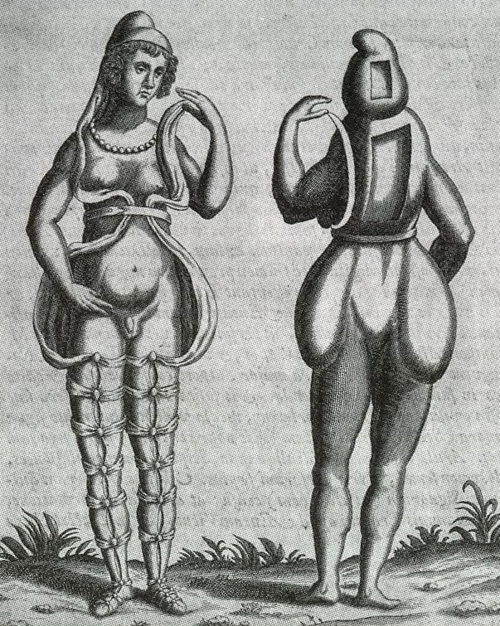
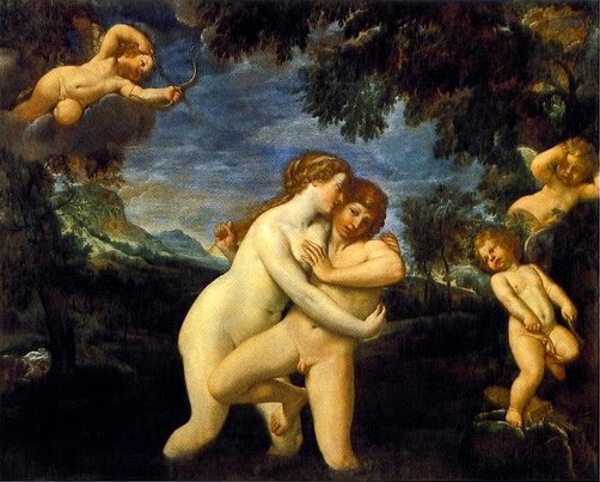
A hermaphrodite is a person who has both ovaries and testes. The name is derived from the Greek myth about the god Hermaphroditus, who became hermaphroditic when he merged with a nymph..
Nowadays, we no longer need gods to explain this remarkable phenomenon. Medical science teaches us that hermaphroditism or pseudohermaphroditism is the result of a defect in sex differentiation, and what may cause this.
In pseudohermaphroditism, the internal sex organs and genetic predisposition are male or female, but the external sex organs are unclear or opposite.
In women with pseudohermaphroditism, the external sex organs resemble those of a man. In men with this condition, they resemble those of a woman.
These people are therefore often raised as someone of the opposite sex.
Source: Jan Dequeker

Pseudohermafroditism
References
Jan Dequeker
The artist and the doctor look at paintings
Photos
wikiart.org
Art lijst
Schilderijen
- Bosch, Hieronymus – The Peddler
- Bosch, Hieronymus_The Haywain triptych
- Botticelli, Sandro_Primavera / Spring
- Brueghel the Elder, Pieter – The Tower of Babel
- Campin, Robert — Mérode Triptych
- Courbet, Gustave_The painters Studio
- Dali, Salvadore_The Temptation of Saint Anthony
- Dou, Gerard_the Quack Doctor
- Eyck van Barthélemy_Still life with books
- Fra Angelico_Annunciation
- Géricault, Théodore_Medusas raft
- Magritte, Rene_Prohibited to depict
- Matsys, Quinten_The money changer and his wife
- Memling, Hans_Two horses in a landscape
- Picasso, Pablo_Guernica
- Rembrandt_Abraham and the Three Angels
- Rembrandt_Elsje Christiaens
- Unknown – 16th century: Four depictions of a physician
- Velazquez, Diego_Las Meninas
Schilderijen en de dokter
- Agenesia Sacrale (a rare congenital disorder in which the fetal development of the lower spine)
- Alopecia areata (hair loss)
- Arthrogryposis congenita (birth defect, joints contracted)
- Artritis psoriatica (inflammatory disease of the joint)
- Artritis reumatoïde
- Breast development (delayed)
- Bubonic plague
- Dental caries
- Diphtheria
- Extraction of the Stone of Madness
- Eye surgery
- Flat foot and Pointed Foot
- Fungal disease_Favus
- Gigantism and Acromegaly
- Goiter (struma)
- Hare lip (cheiloschisis) / cleft palate
- Herpes zoster (shingles)
- Hunger edema
- Influenza Epidemic of 1858
- Insanity - Malle Babbe (1640)
- Leprosy
- Lovesick, pregnancy
- Lymph node tumor (lymphoma), non-Hodgkin
- Manic Depression Psychosis
- Measles / Rubella? (acute viral infection)
- Melanoma or nevus (birthmark)
- Membranous glomerulonephritis
- Murder (pneumothorax, arterial bleeding)
- Neurofibromatosis
- Osteoarthritis / hallux valgus
- Osteomyelitis
- Otitis media (acute middle ear infection)
- Parotitis (mumps)
- Polio
- Prepatellar bursitis
- Progeria
- Pseudohermafroditism
- Pseudopregnancy
- Psychoneurosis (acute)
- Pulmonary tuberculosis
- Rachitic chest
- Rheumatic fever (acute)
- Rhinophyma and rosacea_depression
- Rhinophyma or bulbous nose
- Rhinoscleroma
- Syphilis (hard chancre)
- Ziekte van Paget
Schilders
Historie lijst
- 1632-1723_Antonie van Leeuwenhoek
- 1749-1823_Edward Jenner
- 1818-1865_Ignaz Semmelweis
- 1822-1895_Louis Pasteur
Wetenswaardigheden lijst
- 1887 Psychiatric Hospital
- Animals on duty
- Bizarre advice for parents
- Bloodletting
- Bloodthirsty Hungarian Countess Elizabeth Báthory (1560–1614)
- Butler escaped punishment three times.
- Dance mania / Saint Vitus Dance
- Doctors’ advice did more harm than good
- French Revolution Louis XVI
- Frontal syndrome (Phineas Gage)
- Heart disease (Egyptian princess)
- Ice Age (minor)_1300-1850
- Ivan IV de Verschrikkelijke (1530-1584)
- Kindermishandeling
- Koketteren met koningin Victoria
- Koningin door huidcrème vergiftigd
- Kraambedpsychose (Margery Kempe)
- Massacre in Beirut
- ME stonden bol van de seks
- Mummie bij de dokter
- Plee, Gemak of Kakstoel
- Prostaatkanker (mummie)
- Sexhandel in Londen
- Swaddling baby
- Syfilis was in de mode
- Testikels opofferen
- Tropische ziekten werden veroveraars fataal
- Vrouwen als beul in WOII
- Wie mooi wil zijn moet pijn lijden
- Zonnekoning woonde in een zwijnenstal