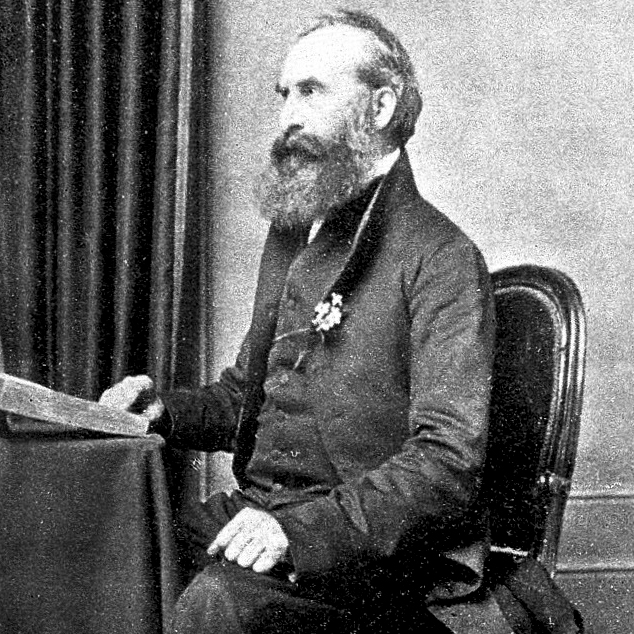
Marinus van Reymerswaele
1490, Reymerswael - 1567, Reymerswael, Zeeland
Marinus van Reymerswaele is one of the most important painters of the Antwerp school in the 16th century. He adopted the excellent painting style of Quinten Massijs, and his works are therefore strongly influenced by it.
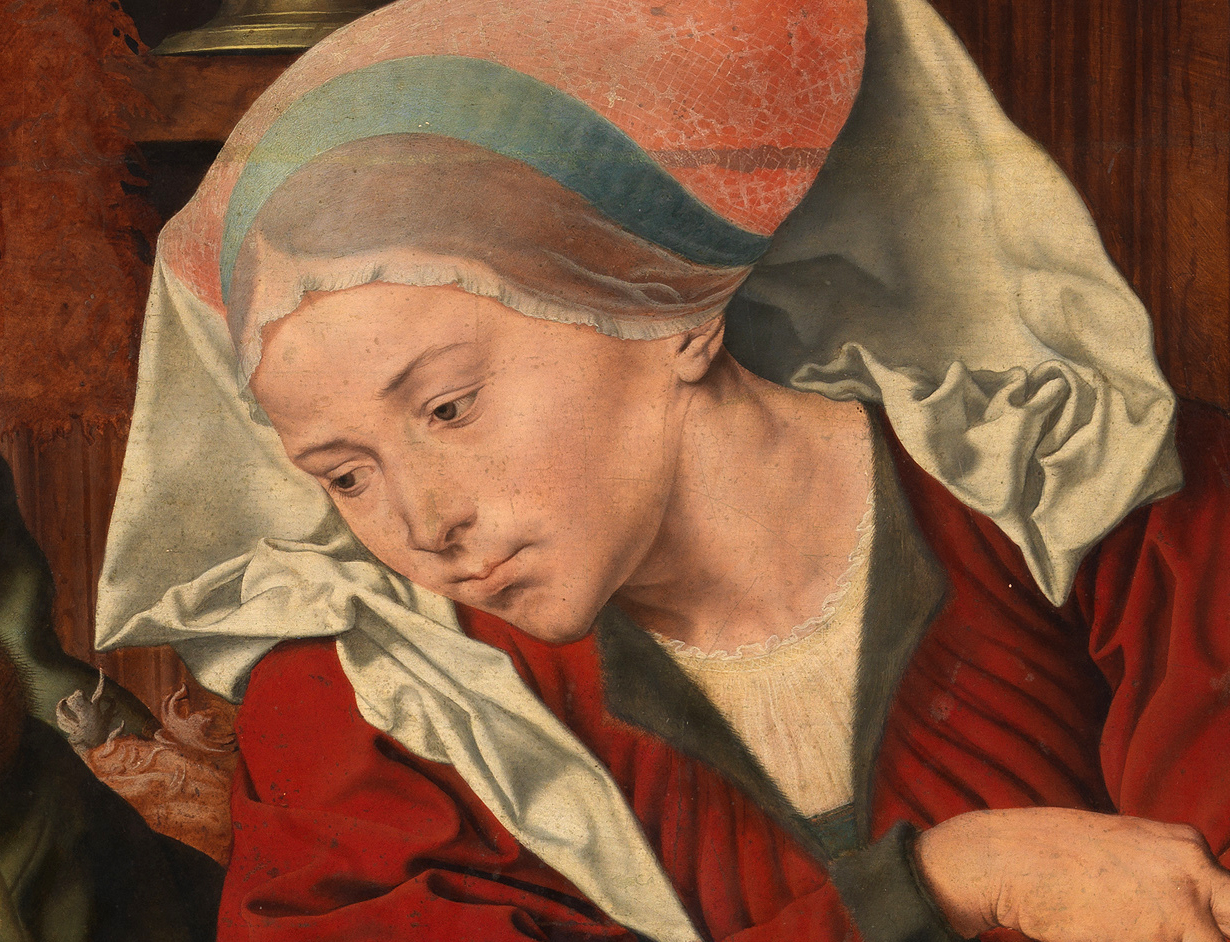
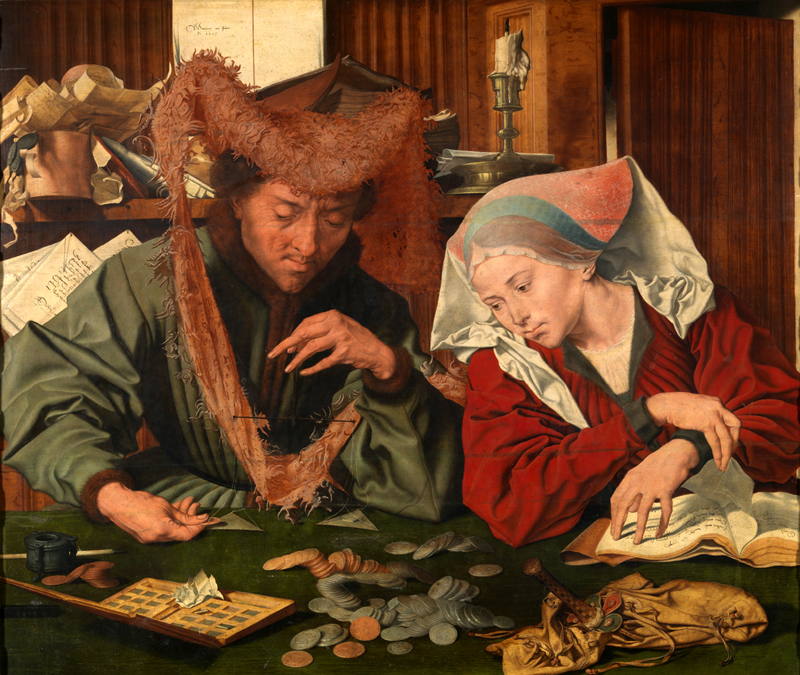
♦ The money changer and his wife (1539) ♦
This painting is not intended, as it may seem, as a mere simple genre scene. It is a moral allegory of greed. The people in the painting are fascinated or, better yet, hypnotized by the gold.
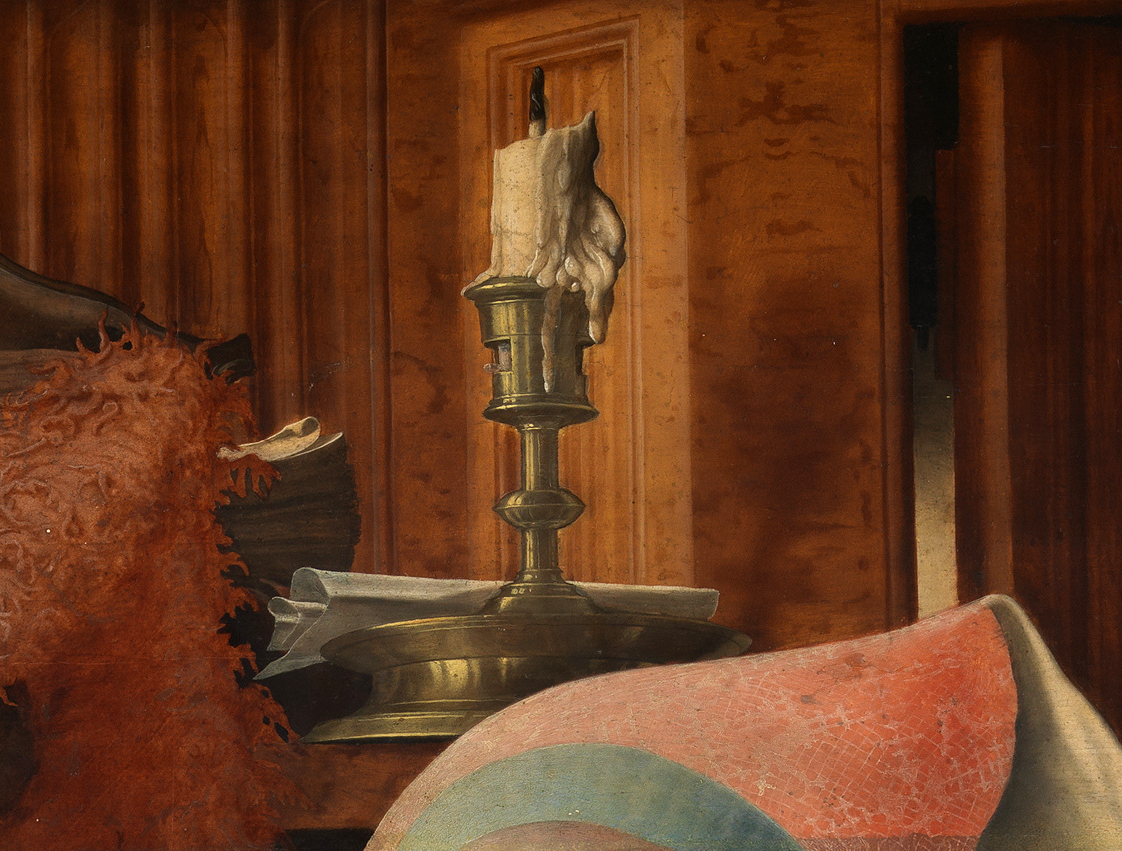
The woman stops reading and lets her gaze wander over the money. Her husband holds the scales like an attribute of the judge, which of course also refers to the Last Judgment. For then our deeds will be weighed as the money changer weighs his gold. Our fleeting existence in this life is symbolized by the half-burned candle on the shelf.
As a whole, this painting reveals a moralistic concern, which is related to the ideas of Erasmus of Rotterdam.
A very similar genre painting, painted by Quinten Massijs, can be found in the Musée du Louvre in Paris.
♦ Diagnosis
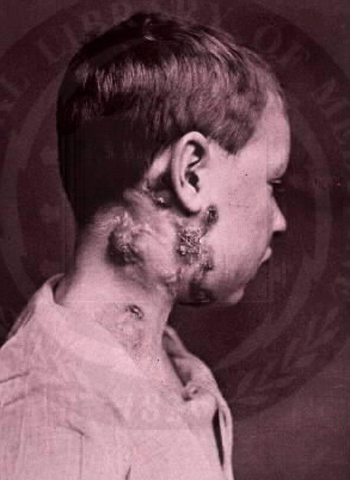
Main symptoms: Swelling of the lymph nodes in the neck that do not break through the skin.
Side effects: Middle-aged woman, looks at money while reading. Pale face and hands.
Clinical diagnosis: Lymph node tumor (lymphoma), non-Hodgkin's disease; tuberculous lymphadenitis (scrofula).
♦ Definition: Lymph node tumor (lymphoma), non-Hodgkin's disease
Hodgkin's disease is characterized by uncontrolled production of typical Reed-Sternberg cells and infiltration of peritumoral lymphocytes, leading to painless but progressive enlargement of lymphatic tissue throughout the body. Ultimately, this leads to anemia.
The lymph nodes in the neck, particularly those on the left side, are often affected first. Fever, with or without symptoms of infection, is quite common, as are heavy night sweats and weight loss.
The disease peaks mainly in two age groups:
1) young men around adolescence
2) 50-60 year olds
If left untreated, the disease quickly becomes fatal. The exception to this is paragranuloma, which progresses more slowly.
Hodgkin's disease in the neck region is often confused with tuberculous lymphadenitis, chronic pyogenic lymphadenitis, chronic lymphocytic leukemia, and infectious mononucleosis.
Non-Hodgkin lymphomas often differ only in pathological symptoms and usually develop in large or small cells of the follicular lymphocytes.
In most cases, a correct diagnosis can only be made by biopsy of a gland.
♦ Definition: scrofula
Glandular disease or tuberculosis of the lymph nodes in the neck.
Skin lesions are caused by the local action of the tubercle bacillus, which spreads directly from a subcutaneous structure. Usually occurs in the neck due to drainage of the lymph nodes, which form ulcers, drainage fistulas, and scars.
♦ Discussion
The diagnosis of lymphoma (non-Hodgkin's disease) is clinically the most likely here, taking into account the age and general appearance of the money changer's wife.
Infectious mononucleosis, also known as glandular fever, is an acute infectious disease, often in young people, with high fever, fatigue, feeling unwell, muscle pain throughout the body, and some enlargement of the superficial glands. Recovery always follows.
Tuberculous lymphadenitis, and certainly chronic pyogenic lymphadenitis, is accompanied by superficial skin changes, adhesions, or redness.
It is unlikely that Marinus van Reymerswaele deliberately painted the signs of a potentially fatal disease in order to reinforce the moral message of this painting—the transience of our existence as symbolized by the half-burned candle.
However, medieval painters were keen observers and depicted typical clinical symptoms of diseases that were not yet recognized by doctors at the time as specific syndromes.
Some 250 years before Thomas Hodgkin's first description (1), Marinus van Reymerswaele had already immortalized the most important clinical symptoms of the disease, as he saw them in his model.
After the publication of this review in a medical journal, Adri Mackor from Doorn (the Netherlands) wrote to me (Jan Dequeker) that, according to his archival research, the models for this painting were Marinus himself and his wife. Marinus van Reymerswaele is said to have moved to Goes in 1540 with a new, young wife.
This could support my diagnosis that the money changer's wife suffered from lymphoma in 1539 and died shortly thereafter, in any case before Marinus moved to Goes with a young wife in 1540.
Thomas Hodgkin (1798-1866), an English physician, described the clinical history and post-mortem findings of seven cases of the disease that would later bear his name in his 1832 treatise, On some morbid appearance of the absorbent glands and spleen.
The first microscopic descriptions of Hodgkin's disease were made in 1872 by Lanhans.
(1) Hodgkin T., On some morbid appearance of the absorbent glands and spleen. Med Chir Trans 1832; 17: 68-114
Source: Jan Dequeker

Lymph node tumor (lymphoma), non-Hodgkin
References
Jan Dequeker
The artist and the doctor look at paintings Photos
Wikipedia.org
Wikimedia.org
Art lijst
Schilderijen
- Bosch, Hieronymus – The Peddler
- Bosch, Hieronymus_The Haywain triptych
- Botticelli, Sandro_Primavera / Spring
- Brueghel the Elder, Pieter – The Tower of Babel
- Campin, Robert — Mérode Triptych
- Courbet, Gustave_The painters Studio
- Dali, Salvadore_The Temptation of Saint Anthony
- Dou, Gerard_the Quack Doctor
- Eyck van Barthélemy_Still life with books
- Fra Angelico_Annunciation
- Géricault, Théodore_Medusas raft
- Magritte, Rene_Prohibited to depict
- Matsys, Quinten_The money changer and his wife
- Memling, Hans_Two horses in a landscape
- Picasso, Pablo_Guernica
- Rembrandt_Abraham and the Three Angels
- Rembrandt_Elsje Christiaens
- Unknown – 16th century: Four depictions of a physician
- Velazquez, Diego_Las Meninas
Schilderijen en de dokter
- Agenesia Sacrale (a rare congenital disorder in which the fetal development of the lower spine)
- Alopecia areata (hair loss)
- Arthrogryposis congenita (birth defect, joints contracted)
- Artritis psoriatica (inflammatory disease of the joint)
- Artritis reumatoïde
- Breast development (delayed)
- Bubonic plague
- Dental caries
- Diphtheria
- Extraction of the Stone of Madness
- Eye surgery
- Flat foot and Pointed Foot
- Fungal disease_Favus
- Gigantism and Acromegaly
- Goiter (struma)
- Hare lip (cheiloschisis) / cleft palate
- Herpes zoster (shingles)
- Hunger edema
- Influenza Epidemic of 1858
- Insanity - Malle Babbe (1640)
- Leprosy
- Lovesick, pregnancy
- Lymph node tumor (lymphoma), non-Hodgkin
- Manic Depression Psychosis
- Measles / Rubella? (acute viral infection)
- Melanoma or nevus (birthmark)
- Membranous glomerulonephritis
- Murder (pneumothorax, arterial bleeding)
- Neurofibromatosis
- Osteoarthritis / hallux valgus
- Osteomyelitis
- Otitis media (acute middle ear infection)
- Parotitis (mumps)
- Polio
- Prepatellar bursitis
- Progeria
- Pseudohermafroditism
- Pseudopregnancy
- Psychoneurosis (acute)
- Pulmonary tuberculosis
- Rachitic chest
- Rheumatic fever (acute)
- Rhinophyma and rosacea_depression
- Rhinophyma or bulbous nose
- Rhinoscleroma
- Syphilis (hard chancre)
- Ziekte van Paget
Schilders
Historie lijst
- 1632-1723_Antonie van Leeuwenhoek
- 1749-1823_Edward Jenner
- 1818-1865_Ignaz Semmelweis
- 1822-1895_Louis Pasteur
Wetenswaardigheden lijst
- 1887 Psychiatric Hospital
- Animals on duty
- Bizarre advice for parents
- Bloodletting
- Bloodthirsty Hungarian Countess Elizabeth Báthory (1560–1614)
- Butler escaped punishment three times.
- Dance mania / Saint Vitus Dance
- Doctors’ advice did more harm than good
- French Revolution Louis XVI
- Frontal syndrome (Phineas Gage)
- Heart disease (Egyptian princess)
- Ice Age (minor)_1300-1850
- Ivan IV de Verschrikkelijke (1530-1584)
- Kindermishandeling
- Koketteren met koningin Victoria
- Koningin door huidcrème vergiftigd
- Kraambedpsychose (Margery Kempe)
- Massacre in Beirut
- ME stonden bol van de seks
- Mummie bij de dokter
- Plee, Gemak of Kakstoel
- Prostaatkanker (mummie)
- Sexhandel in Londen
- Swaddling baby
- Syfilis was in de mode
- Testikels opofferen
- Tropische ziekten werden veroveraars fataal
- Vrouwen als beul in WOII
- Wie mooi wil zijn moet pijn lijden
- Zonnekoning woonde in een zwijnenstal