

Seen through the eyes of the patient in the 16th century
(1600-1625)
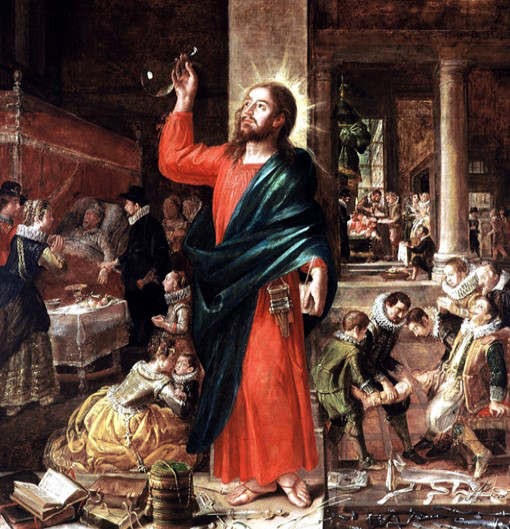
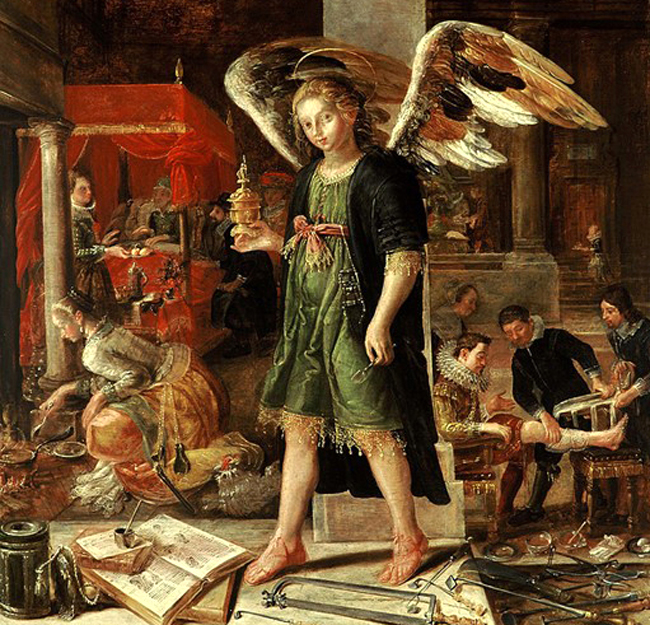
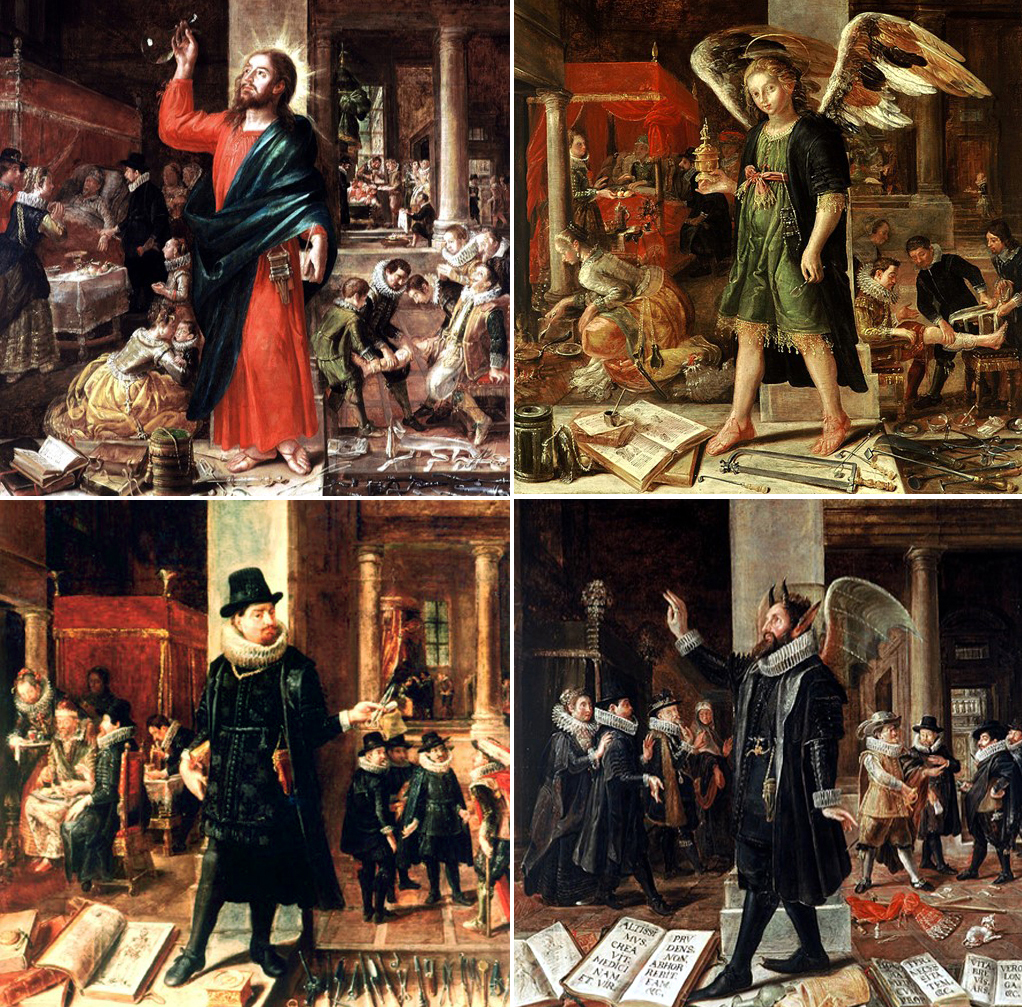
This is the first in a series of four paintings by an unknown Northern Netherlandish artist, depicting the four guises of the doctor as seen through the eyes of the patient in the 16th century.
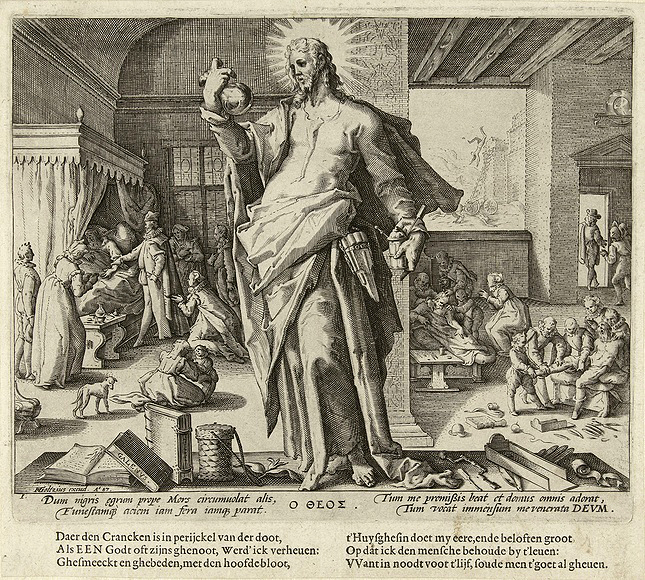
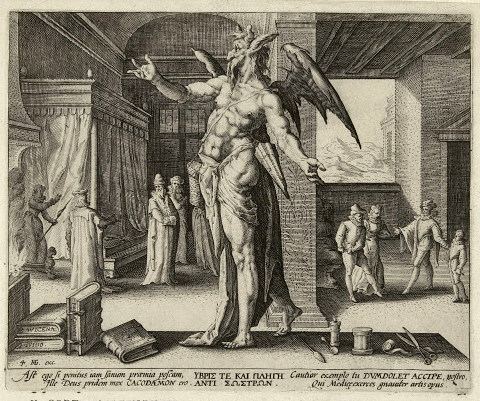
These paintings are based on a series of four engravings from 1587 by Hendrick Goltzius (1558–1617), but they are not exact painted copies of those prints.
♦ First painting
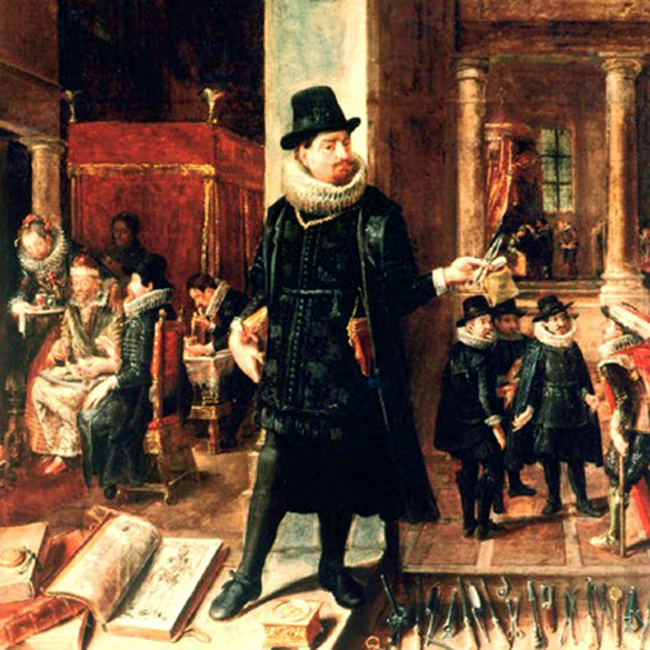
In this first painting, we see the physician as perceived by the seriously ill patient as the great healer who can save his life, equal to God.
Three medical case histories are depicted.
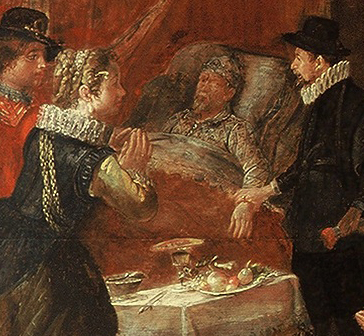
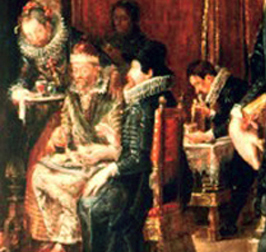
On the left, a patient with a fever lies in bed while the doctor takes his pulse.
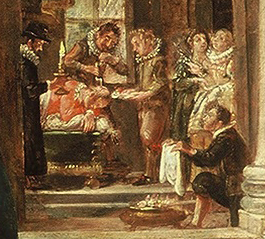
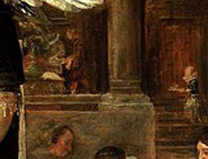
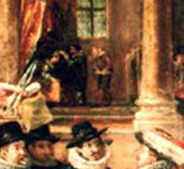
On the right in the background, the physician performs a skull trepanation by candlelight on a patient who has placed his arms beneath his head.
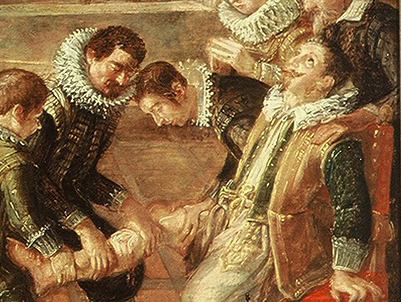
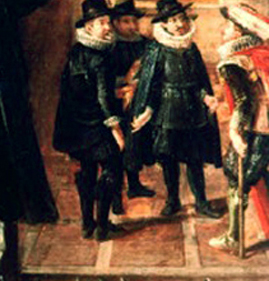
In the right foreground, a fractured leg is being set. The splint is already lying on the ground.
The centrally depicted ‘deified’ physician is performing a uroscopy.
♦ Second painting
The second depiction shows the physician as a saving angel.
The patient is still ill, but the physician is carrying out his healing work.
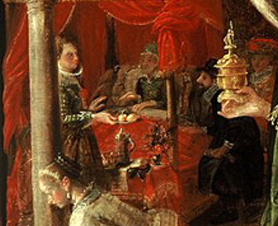
Left: The condition of the feverish patient on the left seems to have improved greatly thanks to the doctor’s medicines and the prepared food.
Right: The trepanned patient in the background of the painting is also doing better.
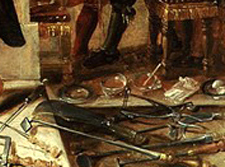
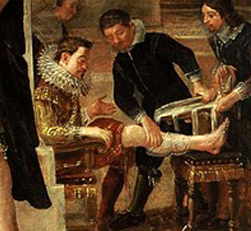
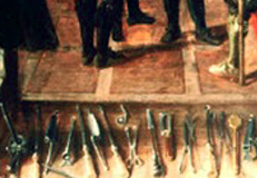
Foreground: And despite the displayed surgical instruments, the patient with the broken leg, shown in the right foreground without a splint, also appears to be recovering.
The accuracy with which the unknown painter depicted the various instruments suggests a close relationship between the artist and a physician. The paintings are so rich in detail that they were probably made for a well-paying patron, such as a guild or a doctor.
♦ Third painting
In this painting, the physician is seen as a man.
Left: The patient on the left side of the painting is clearly recovering and is now allowed to leave the bed again.
Right: In the background on the right, the trepanation opening in the patient’s skull is being inspected.
Foreground: The patient in the right foreground, who had broken his leg, is back on his feet again—albeit with the help of a walking stick.
The once so threateningly displayed surgical instruments have been neatly put away.
Everyone appears satisfied.
♦ Fourth painting
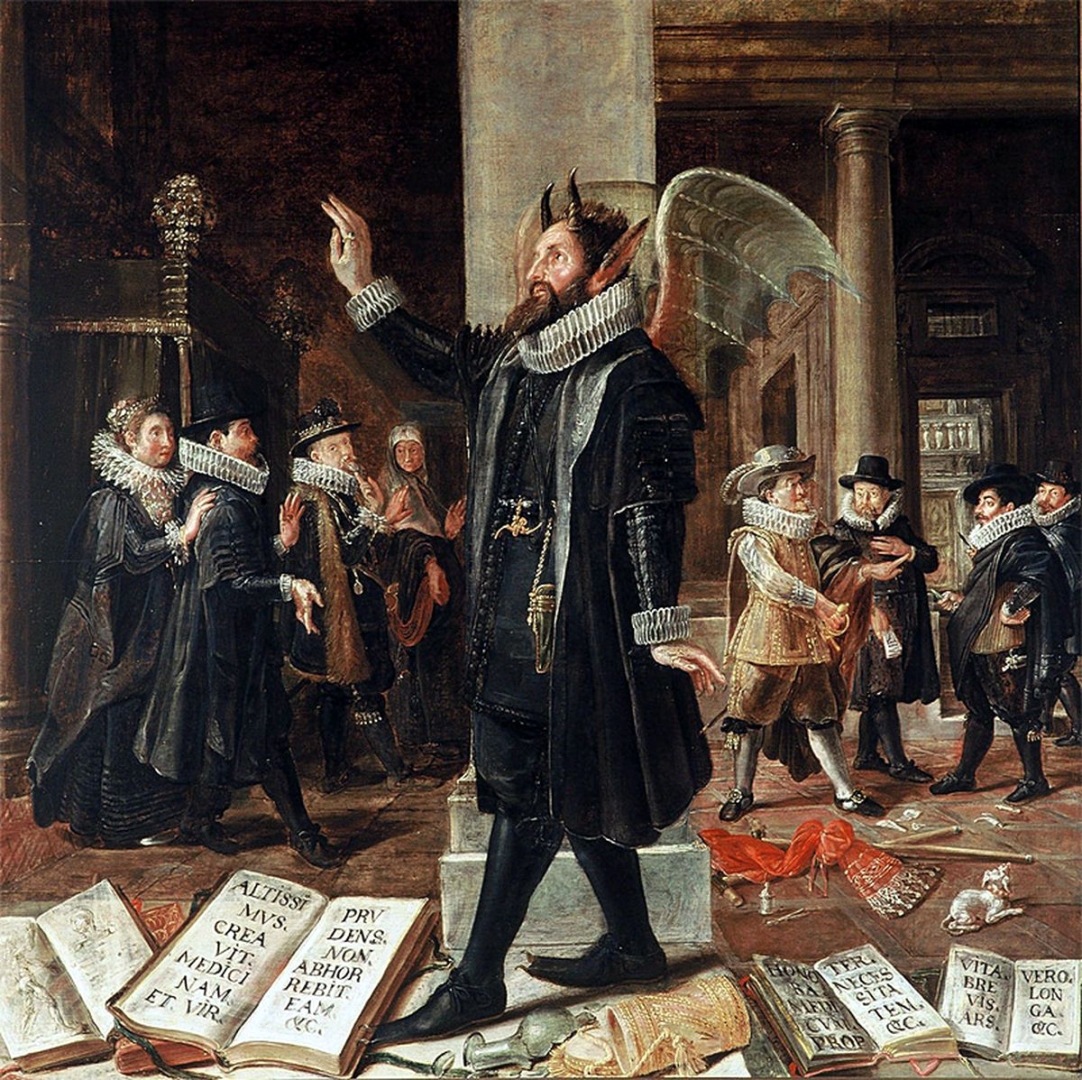
He sees him as the devil incarnate.
This is the final painting, which together form an allegorical representation of the status of the physician in the eyes of his patient. When the recovered patient receives the doctor’s bill, he sees him as the devil incarnate. The bill has been drawn up, so the good deeds are forgotten.
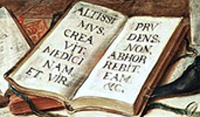
Caution toward this devil-like figure seems advisable, but the motto lying in the left foreground warns against this attitude:
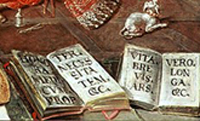
ALTISSIMUS CREAVIT MEDICINAM ET VIR PRUDENS NON ABHORREBIT EAM &C
[The Most High has created medicine, and a wise person will not despise it]. In the right foreground it reads: HONORA MEDICUM PROPTER NECESSITATEM &C VITA BREVIS, ARS VERO LONGA &C
[Honor the physician out of necessity, etc.; life is short, and art indeed long, etc]. Apart from a moralizing lesson about the reward the physician deserves for his good care, these paintings also show many details about the two principal medical professions of the seventeenth century: the medicinae doctores and the surgeons.
In all the paintings, we see the university-trained doctor on the left of the large central figure, engaged in taking the pulse, observing the patient, and prescribing the patient’s diet.
The scenes on the right consistently depict the work of the surgeon: the treatment of a fractured leg in the foreground and the performance of a trepanation, or skull drilling, in the background.
The four paintings, created by an anonymous Northern Netherlandish artist from the 16th/17th century, are currently housed in Museum Boerhaave in Leiden.
Source: NTvG
Netherlands Journal of Medicine

Unknown – 16th century: Four depictions of a physician
References
NTvG
Nederlands Tijdschrift voor Geneeskunde / Netherlands Journal of Medicine
Photos
wikipedia
Art lijst
Schilderijen
- Bosch, Hieronymus – The Peddler
- Bosch, Hieronymus_The Haywain triptych
- Botticelli, Sandro_Primavera / Spring
- Brueghel the Elder, Pieter – The Tower of Babel
- Campin, Robert — Mérode Triptych
- Courbet, Gustave_The painters Studio
- Dali, Salvadore_The Temptation of Saint Anthony
- Dou, Gerard_the Quack Doctor
- Eyck van Barthélemy_Still life with books
- Fra Angelico_Annunciation
- Géricault, Théodore_Medusas raft
- Magritte, Rene_Prohibited to depict
- Matsys, Quinten_The money changer and his wife
- Memling, Hans_Two horses in a landscape
- Picasso, Pablo_Guernica
- Rembrandt_Abraham and the Three Angels
- Rembrandt_Elsje Christiaens
- Unknown – 16th century: Four depictions of a physician
- Velazquez, Diego_Las Meninas
Schilderijen en de dokter
- Agenesia Sacrale (a rare congenital disorder in which the fetal development of the lower spine)
- Alopecia areata (hair loss)
- Arthrogryposis congenita (birth defect, joints contracted)
- Artritis psoriatica (inflammatory disease of the joint)
- Artritis reumatoïde
- Breast development (delayed)
- Bubonic plague
- Dental caries
- Diphtheria
- Extraction of the Stone of Madness
- Eye surgery
- Flat foot and Pointed Foot
- Fungal disease_Favus
- Gigantism and Acromegaly
- Goiter (struma)
- Hare lip (cheiloschisis) / cleft palate
- Herpes zoster (shingles)
- Hunger edema
- Influenza Epidemic of 1858
- Insanity - Malle Babbe (1640)
- Leprosy
- Lovesick, pregnancy
- Lymph node tumor (lymphoma), non-Hodgkin
- Manic Depression Psychosis
- Measles / Rubella? (acute viral infection)
- Melanoma or nevus (birthmark)
- Membranous glomerulonephritis
- Murder (pneumothorax, arterial bleeding)
- Neurofibromatosis
- Osteoarthritis / hallux valgus
- Osteomyelitis
- Otitis media (acute middle ear infection)
- Parotitis (mumps)
- Polio
- Prepatellar bursitis
- Progeria
- Pseudohermafroditism
- Pseudopregnancy
- Psychoneurosis (acute)
- Pulmonary tuberculosis
- Rachitic chest
- Rheumatic fever (acute)
- Rhinophyma and rosacea_depression
- Rhinophyma or bulbous nose
- Rhinoscleroma
- Syphilis (hard chancre)
- Ziekte van Paget
Schilders
Historie lijst
- 1632-1723_Antonie van Leeuwenhoek
- 1749-1823_Edward Jenner
- 1818-1865_Ignaz Semmelweis
- 1822-1895_Louis Pasteur
Wetenswaardigheden lijst
- 1887 Psychiatric Hospital
- Animals on duty
- Bizarre advice for parents
- Bloodletting
- Bloodthirsty Hungarian Countess Elizabeth Báthory (1560–1614)
- Butler escaped punishment three times.
- Dance mania / Saint Vitus Dance
- Doctors’ advice did more harm than good
- French Revolution Louis XVI
- Frontal syndrome (Phineas Gage)
- Heart disease (Egyptian princess)
- Ice Age (minor)_1300-1850
- Ivan IV de Verschrikkelijke (1530-1584)
- Kindermishandeling
- Koketteren met koningin Victoria
- Koningin door huidcrème vergiftigd
- Kraambedpsychose (Margery Kempe)
- Massacre in Beirut
- ME stonden bol van de seks
- Mummie bij de dokter
- Plee, Gemak of Kakstoel
- Prostaatkanker (mummie)
- Sexhandel in Londen
- Swaddling baby
- Syfilis was in de mode
- Testikels opofferen
- Tropische ziekten werden veroveraars fataal
- Vrouwen als beul in WOII
- Wie mooi wil zijn moet pijn lijden
- Zonnekoning woonde in een zwijnenstal